
Chapter 4 of 8
Dismissive-Avoidant With an Anxious Partner: The Survival Guide
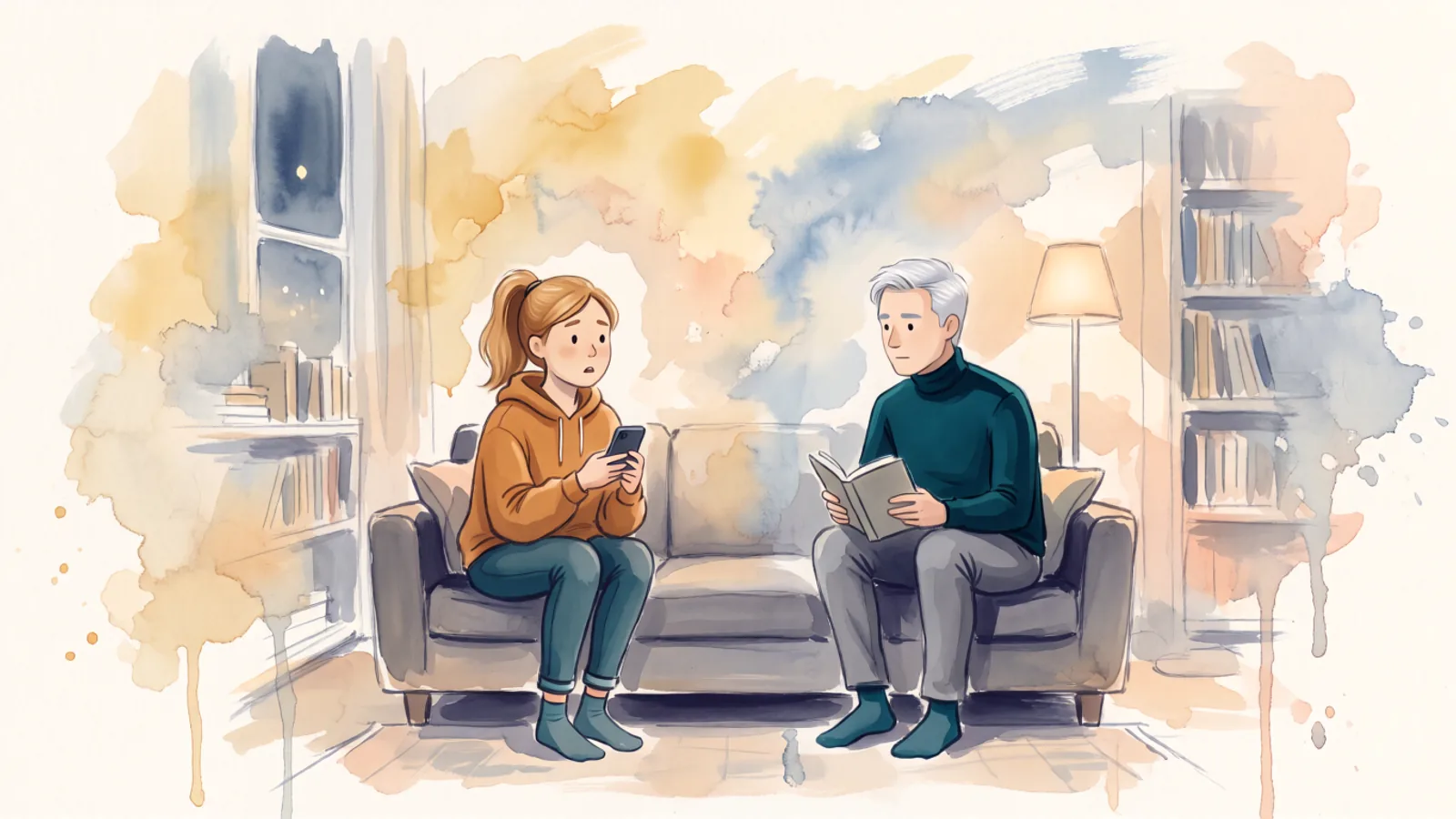
It's Saturday. You had a long week and you want one quiet afternoon: headphones, a run, nobody needing anything. By 3:40 your phone shows four messages. "you ok?" "you've been quiet all day." "did i do something." "ok." You feel the walls move in. You weren't upset. You were just away. Now you're upset.
This guide is for you, the one who needs room, in love with someone who needs reassurance. It isn't a lecture. It explains the loop you're both caught in, why your space lands as a threat, and what you can say so you get your air and they get their answer.
How you're each wired
Researchers now describe attachment as two sliding scales, not four boxes: how much you worry about being left (anxiety) and how much you pull away from closeness (avoidance) [1]. You sit high on avoidance and low on anxiety. Your partner sits the other way round. The labels below are shorthand for those positions.
You: Dismissive-avoidant You tend to see yourself as capable and other people as a bit unreliable, so you handle things alone [2]. That isn't the same as not caring. The research describes dismissing avoidance as a way of playing down the need for closeness and keeping distress out of awareness [3]. Researchers call this a deactivating strategy: when closeness rises, something in you turns the volume down [4]. It probably made sense once. In a relationship it can look like going quiet, getting busy, or noticing everything that's wrong with your partner right when things get close.
Them: Anxious (preoccupied) Your partner runs the opposite strategy. When they sense distance, their attachment system turns up, not down [4]. They tend to doubt their own worth while thinking well of others, so a gap in contact feels like evidence that they're losing you [2]. The checking, the double texts and the "are we ok?" aren't attempts to control you. They're how this wiring tries to get back to calm. Reassurance works on them the way solitude works on you.
What draws you together

At the start it often fits. They're warm, expressive and clearly interested, which saves you from having to make the first emotional move. You're steady and unruffled, which can feel to them like solid ground. Each of you supplies something the other finds hard to produce.
Popular books such as Attached made this pairing famous as the anxious-avoidant trap [11]. The research behind it is thinner than the internet suggests, but it's real. One well-known study of dating couples found that styles didn't pair at random, and that couples made up of an avoidant partner and an anxious partner were surprisingly stable over three years, even though both rated the relationship fairly poorly at the start [5]. So this pairing lasts. Lasting and feeling good are different things, and the rest of this guide is about closing that gap.
Where it goes wrong
The texts
Tuesday, 12:15. They send a photo of their lunch and "miss you." You see it in a meeting, feel a small flicker of warmth, and decide to reply properly later. At 2:30 they send "busy day?" At 5:10: "guess you're busy." By the time you write back at 7:00, "sorry, slammed today," the tone has shifted. To you the gap was nothing. To them it was a five-hour question with no answer. Their follow-ups feel like pressure, so you keep the reply short, which feels to them like more distance.
The arguments
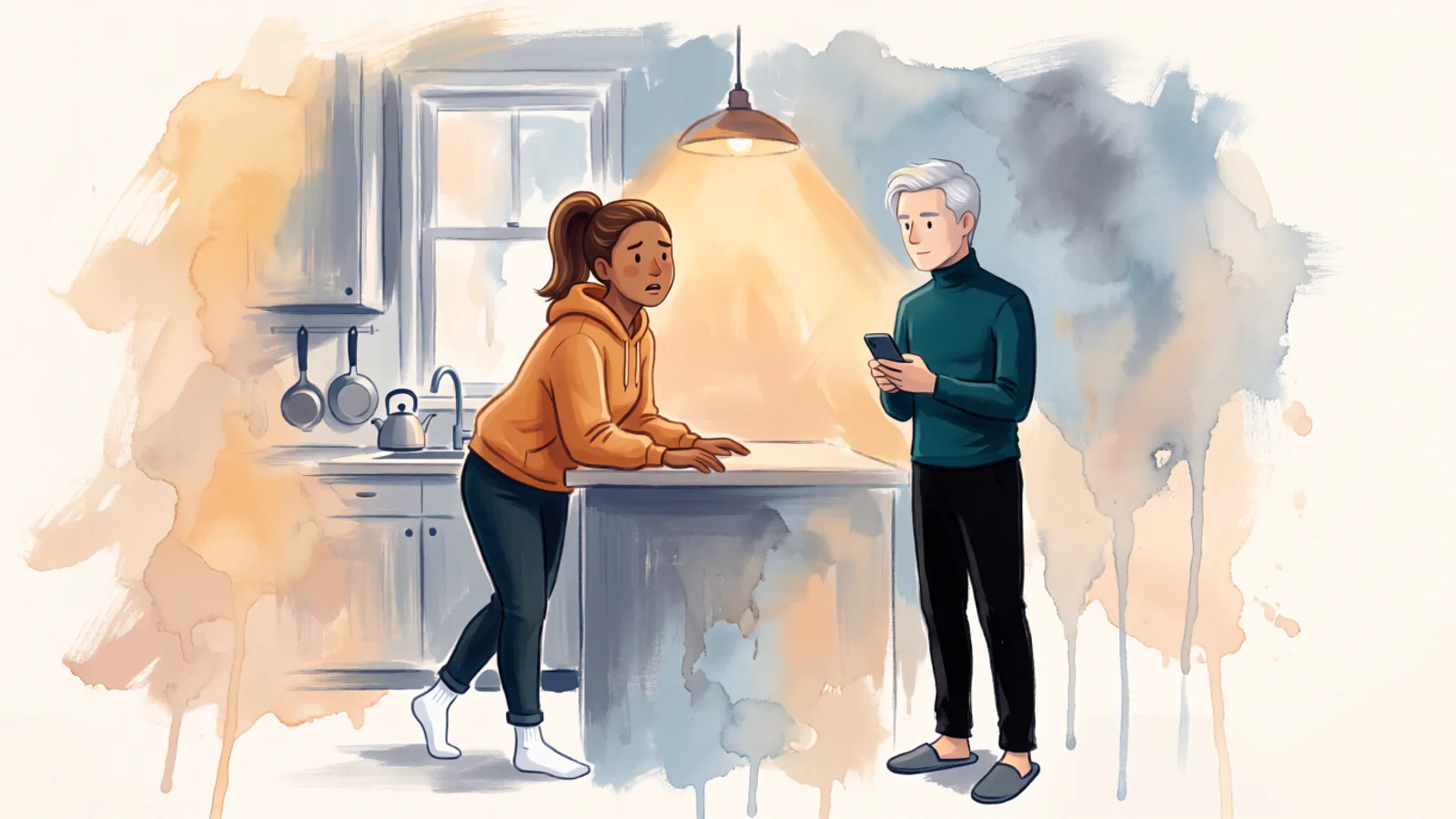
It starts small: "you never tell me what you're feeling." You say you're fine. They press: "you're not fine, you've been somewhere else for a week." You feel cornered and go flat. "I don't want to do this right now." That's the demand/withdraw pattern: one partner pushes with requests and complaints, the other retreats into defensiveness and silence [6]. In studies of couples discussing a problem, more anxious partners came away feeling worse about the relationship, while more avoidant partners were seen as less warm and supportive, especially on big issues [7]. Every time you leave the room, they learn that pushing harder is the only way to reach you. Every time they push, you learn that talking means being cornered.
The distance

A free weekend. They want both days together: brunch, a film, maybe talk about a holiday. You want Saturday morning alone and Sunday with friends. You say "let's play it by ear," which to you means flexible and to them means you don't want to commit. By Sunday night you've had less space than you needed and they've had less closeness than they needed, and you both feel short-changed. Bigger topics follow the same path: moving in, meeting family, next year. The further ahead they look, the more you hedge, and the more you hedge, the further ahead they need to look to feel safe.
What each of you needs
What you need Real time alone that you don't have to defend. Conversations that have a start and an end, so a hard talk doesn't feel like it might never stop. A partner who can hear "I need an hour" without hearing "I'm leaving." And room to process before you speak, because you often don't know what you feel until later.
What they need Predictability more than intensity. They don't need you on the phone all day. They need to know when they'll hear from you, and then to hear from you then. They need you to come back after you step away, and to say something warm out loud now and then instead of assuming they know. Small, regular signals do more for them than one big gesture a month.
Survival strategies

These are things you can do, starting this week. None of them asks you to become a different person. They ask you to make your space readable.
- Announce the step back, with a return time. The pulling away isn't the problem. Doing it without saying so is. Before you go quiet, send one line saying you're taking time and when you'll be back. Then come back when you said you would. That second part builds trust.
- Send a small signal before the gap gets long. If you know a day will be packed, send a short text early. It costs you ten seconds and saves them an afternoon of guessing. Think of it as maintenance, not performance.
- Pause arguments, don't exit them. When you feel flat and cornered, that's your cue. Name it, set a time to come back to it, and leave the room without leaving the conversation. A pause with a time attached is not the same as a slammed door.
- Check the flaw-finding. When you notice yourself cataloguing their faults, ask whether those faults only seem to matter when things get closer. Often the irritation is the deactivating strategy talking, not a real verdict on them [4].
- Practise one small disclosure a week. Tell them something you'd normally keep: a worry about work, something you liked about them, a thing you need. Low stakes, regularly. It gets easier with repetition.
For the text before you go quiet:
heads up, i'm wiped and going offline till about 8. not upset, nothing's wrong. i'll call you after.
For the middle of the argument, when you want to walk out:
I'm shutting down and I don't want to say something unfair. Can we stop for 30 minutes? I'll come back and we'll finish this.
For the weekend plan, so "play it by ear" doesn't land as a no:
I want Saturday night with you. I need Saturday morning to myself. Can we plan Sunday tomorrow?
When it works
When this pairing works, it looks ordinary. You take your Saturday morning and they know you'll be back at noon, so they don't text at 10. They tell you they're spiralling, and you say "I'm here, I'm not going anywhere" without it feeling like a cage. Arguments still happen, but you pause instead of vanishing, and they wait instead of chasing. Over time each of you can steady the other: partners who respond in ways that fit the other person's wiring can help them feel calmer and act more constructively [8]. Couples in steady relationships tend to become more secure over the years, not less [9]. And the biggest predictors of how a relationship feels are things like trust, appreciation and how you handle conflict, not which labels you started with [10]. That's good news for you, because all of those are behaviours.
Red flags it isn't working
- You've had the same argument about "never being available" for months, and nothing about how you take space has changed.
- You feel relief, not just rest, every time you're apart, and dread every time you come back.
- They've stopped asking for anything. That can look like calm, but it's often someone giving up.
- You keep promising return times and missing them, and you both know it.
- Closeness feels like a test you're always failing, and you've stopped wanting to pass it.
If these sound familiar, you have a real choice to make. You can decide to work on staying, deliberately, with the steps above. Or you can decide, honestly and clearly, that you don't want this relationship, and tell them so instead of letting distance say it for you. Both are better than drifting.
Sources (11)
- Fraley, R. C. A Brief Overview of Adult Attachment Theory and Research. University of Illinois. https://labs.psychology.illinois.edu/~rcfraley/attachment.htm (accessed 2026-10-05). Covers Bowlby, Ainsworth, Hazan & Shaver and Brennan, Clark & Shaver's two dimensions.
- Bartholomew, K., & Horowitz, L. M. (1991). Attachment styles among young adults: A test of a four-category model. Journal of Personality and Social Psychology, 61(2), 226–244. https://doi.org/10.1037/0022-3514.61.2.226 (abstract; accessed 2026-10-05)
- Bartholomew, K. (1990). Avoidance of intimacy: An attachment perspective. Journal of Social and Personal Relationships, 7(2), 147–178. https://doi.org/10.1177/0265407590072001 (abstract; accessed 2026-10-05)
- Mikulincer, M., & Shaver, P. R. (2003). The attachment behavioral system in adulthood: Activation, psychodynamics, and interpersonal processes. Advances in Experimental Social Psychology, 35, 53–152. https://doi.org/10.1016/S0065-2601(03)01002-5 (metadata only; cited for the hyperactivating/deactivating terms; accessed 2026-10-05)
- Kirkpatrick, L. A., & Davis, K. E. (1994). Attachment style, gender, and relationship stability: A longitudinal analysis. Journal of Personality and Social Psychology, 66(3), 502–512. https://doi.org/10.1037/0022-3514.66.3.502 (abstract; one sample of heterosexual dating couples; accessed 2026-10-05)
- Christensen, A., & Heavey, C. L. (1990). Gender and social structure in the demand/withdraw pattern of marital conflict. Journal of Personality and Social Psychology, 59(1), 73–81. https://doi.org/10.1037/0022-3514.59.1.73 (abstract; not an attachment study; accessed 2026-10-05)
- Simpson, J. A., Rholes, W. S., & Phillips, D. (1996). Conflict in close relationships: An attachment perspective. Journal of Personality and Social Psychology, 71(5), 899–914. https://doi.org/10.1037/0022-3514.71.5.899 (abstract; accessed 2026-10-05)
- Simpson, J. A., & Overall, N. C. (2014). Partner buffering of attachment insecurity. Current Directions in Psychological Science, 23(1), 54–59. https://doi.org/10.1177/0963721413510933 (abstract; accessed 2026-10-05)
- Davila, J., Karney, B. R., & Bradbury, T. N. (1999). Attachment change processes in the early years of marriage. Journal of Personality and Social Psychology, 76(5), 783–802. https://doi.org/10.1037/0022-3514.76.5.783 (abstract; accessed 2026-10-05)
- Joel, S., Eastwick, P. W., et al. (2020). Machine learning uncovers the most robust self-report predictors of relationship quality across 43 longitudinal couples studies. PNAS, 117(32), 19061–19071. https://doi.org/10.1073/pnas.1917036117 (abstract and significance statement; accessed 2026-10-05)
- Levine, A., & Heller, R. S. F. (2010). Attached: The New Science of Adult Attachment and How It Can Help You Find—and Keep—Love. TarcherPerigee. https://openlibrary.org/works/OL16929630W (bibliographic record only; popular source of the anxious-avoidant framing; accessed 2026-10-05)
Keep going
Anxious With a Dismissive-Avoidant Partner: The Survival Guide
The more you reach, the more they pull back. Why the anxious-avoidant loop runs, what each of you needs, and how to step out of the chase.
Why: hand-picked as a companion
Dismissive-Avoidant With a Dismissive-Avoidant Partner: The Survival Guide
Two people who both turn closeness down. It feels easy, until nobody reaches first. How to keep the calm and stop the drift.
Why: hand-picked as a companion
Fearful-Avoidant With an Anxious Partner: The Survival Guide
Their closeness feels like home, then like a wall closing in. How to stop swinging and give an anxious partner something steady.
Why: same topic: deactivation and distance
More like this
- Guide Dismissive-Avoidant With a Secure Partner: The Survival Guide
- Quiz What's your attachment style?
- Quiz What's your texting-era attachment energy?
- Term Avoidant attachment
- Term Dismissive-avoidant attachment
- Guide Anxious With an Anxious Partner: The Survival Guide
- Guide Dismissive-Avoidant Push-Pull, for an Anxious Partner: The Survival Guide
- Guide Dismissive-Avoidant With a Fearful-Avoidant Partner: The Survival Guide
- Guide Secure With an Anxious Partner: The Survival Guide