
Chapter 4 of 8
Secure With an Anxious Partner: The Survival Guide

You were at dinner with your sister. Phone face down, because that's what you do at dinner. When you picked it up at 9:40 there were four messages, the last one just "ok." You didn't do anything wrong. You also know, from the shape of that "ok.", that the next hour is going to be about reassurance.
This guide is for the steady one. It covers why your calm doesn't always land, what your partner is actually asking for, and how to give a lot without giving yourself away.
How you're each wired
Researchers now describe attachment as two sliding scales, attachment anxiety and attachment avoidance, rather than as four tidy boxes [1]. Everyone sits somewhere on both. The labels below are shorthand for where you each tend to sit, not verdicts.
You: Secure You sit low on both scales. A late reply is a late reply. You can get close without losing yourself, and you can be apart without reading it as rejection. When something bothers you, you tend to say so, and you expect it to be taken seriously. Conflict is uncomfortable, but you trust it can be repaired. That doesn't make you immune. Stress, a run of bad news or a partner whose fear keeps escalating can push your own anxiety or avoidance up for a while.
Them: Anxious (preoccupied) Your partner sits higher on anxiety. Researchers call their way of coping a hyperactivating strategy: when closeness feels uncertain, the attachment system turns up, not down [2]. In plain words, they scan for signs of distance, read silence as information and look for proof that things are fine. This was learned, usually from care that was loving but unpredictable. It isn't neediness as a character trait. It's a smoke alarm set a little too sensitive, and it goes off on toast.
What draws you together

The pull is real on both sides. Your partner is often warm, attentive and quick to open up. They notice things. They want closeness, which means you rarely have to guess whether they're interested. For you, that can feel like being fully seen.
For them, you are the person who replies, follows through and doesn't punish them for having feelings. That is rarer than it should be. Research on partner buffering suggests that how an insecure person's relationship goes depends partly on how their partner responds to them, and that some partners help anxious people feel better and act more constructively [3]. You may be that partner. That's a strength, as long as it doesn't quietly become a job.
Where it goes wrong
The texts
Here is the loop. 7:05pm, they send: "how's the work thing going?" You're in the work thing. 8:30pm: "hope it's ok". 9:15pm: "guess you're busy". 9:40pm: "ok." You see all four at once and reply, "sorry, was slammed, all good!" To you that closes it. To them it doesn't answer the question underneath, which was never about the work thing. It was "are we ok?" So they ask again, more carefully, and you start to feel managed. Neither of you is lying. You're running two different alarm settings.
The arguments
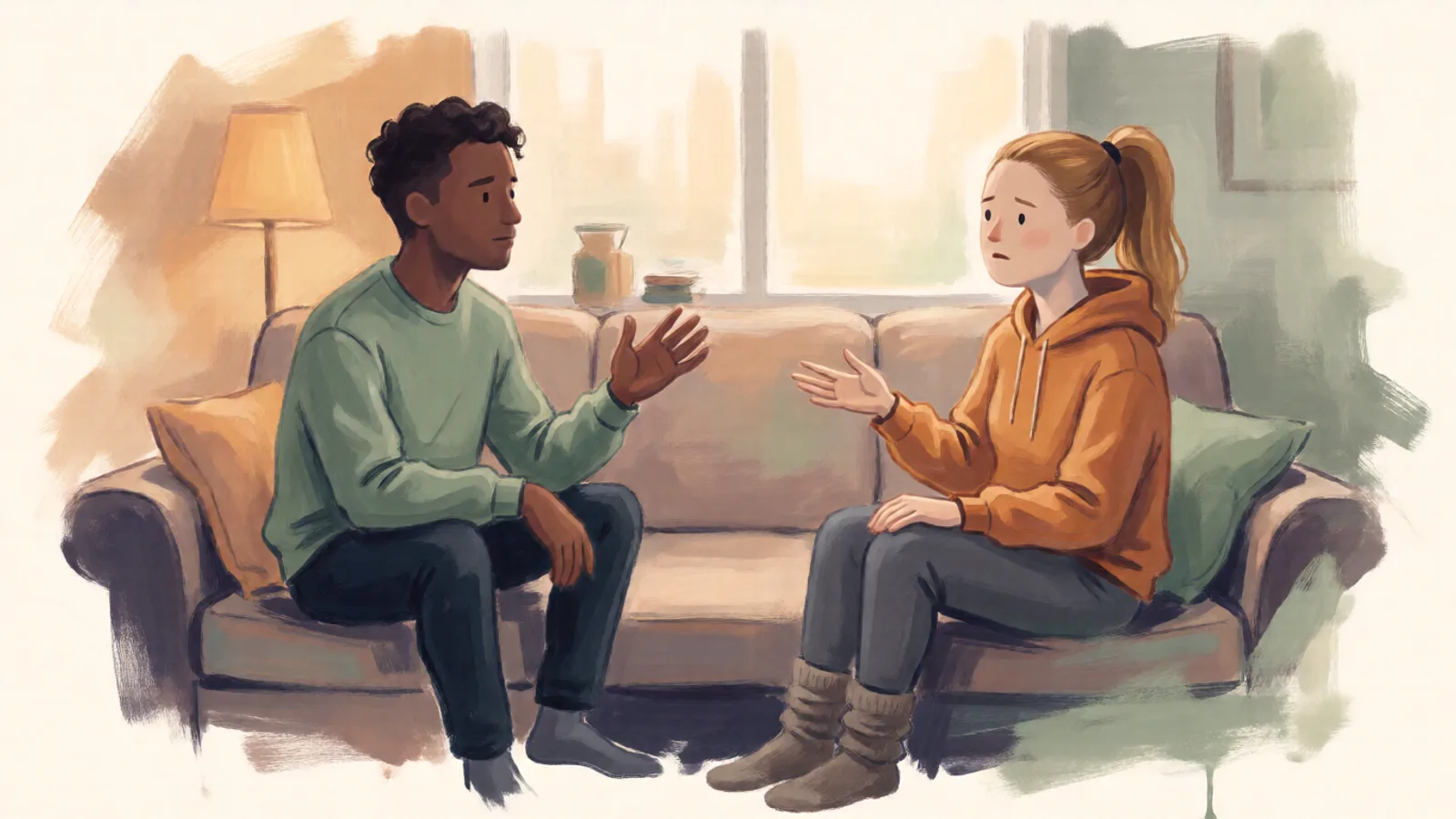
The argument usually starts with something small: plans, a slow reply, a friend you didn't mention. They push for an answer: "I just need to know where I stand." You explain, calmly and logically, that nothing is wrong. They hear "your feelings are an overreaction" and push harder. You get tired and go quiet, or say, "I can't keep having this conversation." Researchers call this the demand/withdraw pattern: one partner presses with requests and complaints while the other retreats [4]. It isn't fixed by personality. The same study found people tend to demand when they want something changed and withdraw when the partner does [4]. So even a secure partner can end up in the withdrawing chair, and it feels terrible from both seats.
The distance
You want a weekend away with your friends. You say it plainly, three weeks ahead, because that's what you'd want. They say "of course, have fun," and mean it. Then Saturday arrives, the group chat is loud, you text less than usual, and by Sunday night they're quiet and hurt. You come home feeling like you did something wrong by having a life. Over months, this can teach you to shrink your plans to avoid the fallout, and teach them that your time apart is a threat. Neither lesson is true. Both get harder to unlearn the longer they run.
What each of you needs
What you need You need room to have a life without it being treated as evidence. You need your word to count: when you say "we're fine", that has to mean something. You need to be allowed to be tired, quiet or busy without it turning into a crisis. And you need a partner who is working on their side of the pattern, not one who hands you the whole job of keeping them calm.
What they need They need predictability more than grand reassurance. Small, regular signals do more than long speeches after the fact: a text when plans change, a time you'll be back, a goodnight on the nights you're apart. They need their feelings treated as real, even when the facts behind them aren't. "That sounds rough, I'm here" lands. "There's no reason to feel that way" doesn't. They also need you to stay in the room during conflict, even when you want to step out.
Survival strategies

- Front-load the reassurance. Before a busy day or a weekend apart, tell them when you'll be in touch, then do it. One "heading into the thing, back around 9" costs you ten seconds and saves an evening. Predictable beats perfect.
- Answer the question underneath. When "how's the work thing?" turns into "ok.", don't just explain the delay. Answer what they were really asking: are we ok? Say it directly, once, warmly.
- Don't argue facts against feelings. In the middle of the argument loop, skip the evidence. Acknowledge the feeling first, then say what's true. "I get why that felt bad" and "I'm not going anywhere" can both be said in one breath.
- Take breaks with a return time. If you need to stop, say when you'll come back to it, and come back. Walking out with no time attached is exactly what an anxious system reads as abandonment.
- Name the pattern on a calm day. Not mid-fight. Over coffee, on a good week, say what you've noticed and ask what helps. You're on the same side against the loop, not against each other.
- Keep your own limits. You can be generous and still say no to checking in every hour, or to defending every friend you see. Supporting them is your choice. Being the only thing that calms them isn't sustainable.
- Keep leaving on the table, honestly. If the pattern stays the same after real effort from you and none from them, you're allowed to decide this isn't the relationship you want. That's a decision about your life, not a punishment for their fear.
A text you could send tonight, before a night out:
heading out with sam, phone's going in my pocket. i'll text when i'm leaving, probably around 11. love you
What to say when the argument starts to loop:
i'm not leaving and i'm not angry. i need twenty minutes to think, then i'll come back and we'll finish this. i promise
For the calm-day conversation:
i've noticed when i go quiet you get worried, and when you get worried i go quieter. can we figure out what actually helps you on those nights?
When it works

It looks quiet, in a good way. You text when you said you would, so they stop watching the phone. They tell you when they're spiraling instead of testing you, and you answer the real question. Your weekends away stop being events. Arguments still happen, but they end with a repair, not a standoff. Over time, the alarm gets less sensitive. Research on newlyweds found that, on average, people became more secure over the early years of marriage, with real variation between couples [5]. A steady partner can be part of that. It's not guaranteed, and it's not your project to finish. But it happens.
Red flags it isn't working
Pairings matter less than how a relationship actually feels day to day: a large study of 43 couples datasets found that a person's own sense of commitment, appreciation and conflict predicted relationship quality far better than either partner's attachment style [6]. So watch the relationship, not the label.
- You've had the same argument about texting, or plans, for six months, and nothing has shifted.
- You've started cancelling plans with friends to avoid the fallout, and you resent it.
- No amount of reassurance lasts more than a day, and they aren't doing anything on their side to change that.
- You feel like a full-time regulator, not a partner, and you've stopped saying how you feel.
- Your own calm is wearing thin: you're checking your phone with dread, not affection.
If several of these are true, you get to decide what happens next: talk honestly, try something new together, or leave with your steadiness intact.
Sources (6)
- Fraley, R. C. A Brief Overview of Adult Attachment Theory and Research. University of Illinois. https://labs.psychology.illinois.edu/~rcfraley/attachment.htm (accessed 2026-10-05)
- Mikulincer, M., & Shaver, P. R. (2003). The attachment behavioral system in adulthood: Activation, psychodynamics, and interpersonal processes. Advances in Experimental Social Psychology, 35, 53–152. https://doi.org/10.1016/S0065-2601(03)01002-5 (metadata only; accessed 2026-10-05)
- Simpson, J. A., & Overall, N. C. (2014). Partner buffering of attachment insecurity. Current Directions in Psychological Science, 23(1), 54–59. https://doi.org/10.1177/0963721413510933 (abstract; accessed 2026-10-05)
- Christensen, A., & Heavey, C. L. (1990). Gender and social structure in the demand/withdraw pattern of marital conflict. Journal of Personality and Social Psychology, 59(1), 73–81. https://doi.org/10.1037/0022-3514.59.1.73 (abstract; accessed 2026-10-05)
- Davila, J., Karney, B. R., & Bradbury, T. N. (1999). Attachment change processes in the early years of marriage. Journal of Personality and Social Psychology, 76(5), 783–802. https://doi.org/10.1037/0022-3514.76.5.783 (abstract; accessed 2026-10-05)
- Joel, S., Eastwick, P. W., et al. (2020). Machine learning uncovers the most robust self-report predictors of relationship quality across 43 longitudinal couples studies. PNAS, 117(32), 19061–19071. https://doi.org/10.1073/pnas.1917036117 (abstract; accessed 2026-10-05)
Keep going
Secure With a Secure Partner: The Survival Guide
Two secure partners start with an advantage, not a guarantee. How to keep the calm from turning into coasting, with scripts for the slow…
Why: hand-picked as a companion
Anxious With a Secure Partner: The Survival Guide
Your alarm is used to chasing. Their steadiness gives it nothing to chase. How to stop testing a calm partner and let it work.
Why: hand-picked as a companion
Anxious With an Anxious Partner: The Survival Guide
Two people who both reach. It can feel like finally being met, until both alarms go off at once. How to keep the closeness and calm the…
Why: same topic: protest behaviour
More like this
- Quiz What's your attachment style?
- Quiz What's your texting-era attachment energy?
- Guide Dismissive-Avoidant With an Anxious Partner: The Survival Guide
- Guide Fearful-Avoidant With an Anxious Partner: The Survival Guide
- Guide Secure With a Fearful-Avoidant Partner: The Survival Guide
- Term Anxious attachment
- Article Protest behaviour: what it is and why you did it
- Term Avoidant attachment
- Term Dismissive-avoidant attachment