
Chapter 3 of 8
Anxious With a Secure Partner: The Survival Guide
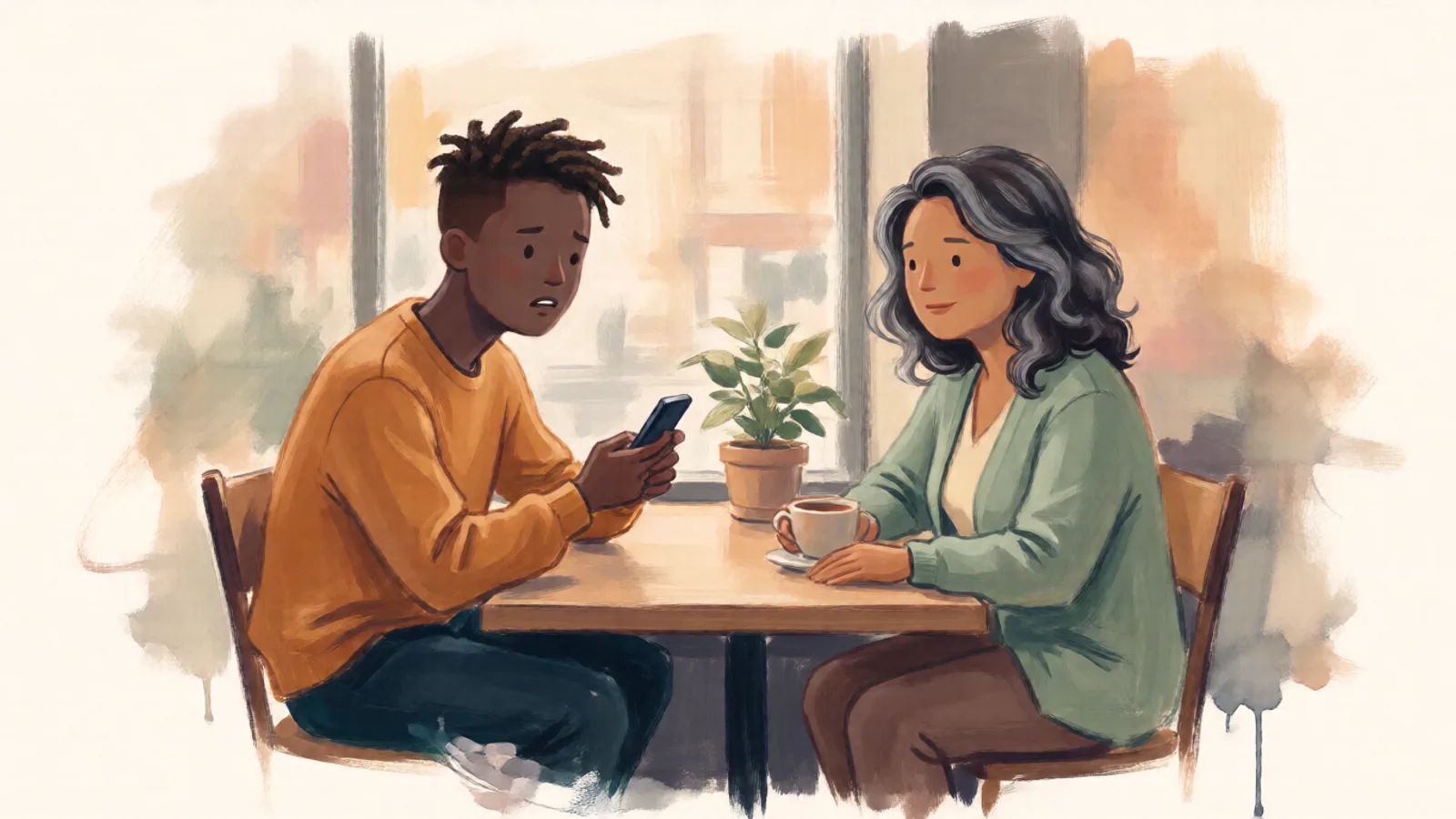
It's Saturday, 10:20. They said they'd call after their run. They haven't yet. Nothing is wrong. They told you on Thursday they love you, they booked the cabin for next month, and their last text had a heart in it. Your chest is already tight anyway. You've drafted "all good?" three times.
This is the strange part of being anxious with someone steady: the danger has gone, but the alarm hasn't heard yet. This guide is about letting it catch up.
How you're each wired
Attachment researchers describe two sliding scales rather than four boxes: attachment anxiety (how much you worry about being left) and attachment avoidance (how uneasy closeness makes you) [1]. You sit higher on the first. Your partner sits low on both. These are tendencies, not fixed identities.
You: Anxious (preoccupied) In Bartholomew and Horowitz's model, preoccupied means a shakier view of yourself alongside a hopeful view of other people [2]. You believe love is out there. You're less sure you'll get to keep it. So your system stays switched on, scanning reply times, tone and small changes in plans. When it picks up a gap, the urge is to close it fast: text, ask, fix, reassure. The alarm is a learned strategy for staying close to someone who might not stay. It isn't a flaw in you.
Them: Secure Someone who leans secure tends to hold a reasonably good view of themselves and of others [2]. Closeness doesn't scare them and distance doesn't panic them. A late reply means they're busy. A quiet evening means they're tired. They aren't running a calm act or hiding a strategy. That's simply how their system reads things. They still have moods, limits and bad weeks. Secure isn't the same as infinitely easygoing.
What draws you together
The pull here is quieter than the rush you may be used to. They say what they mean. They turn up when they said they would. They answer your question instead of turning it into a debate about whether you should have asked it. For a system tuned to uncertainty, that can feel like relief, and sometimes, at first, like boredom.
Research backs the relief. Some partners "buffer" a partner's insecurity, and when that happens the anxious partner tends to feel better and act more constructively, and the relationship improves [3]. That doesn't make your partner your rescuer. It means the steadiness you're drawn to is doing something real.
Where it goes wrong
The risk in this pairing isn't the classic chase. It's you bringing the chase with you when there's nobody running.
The texts
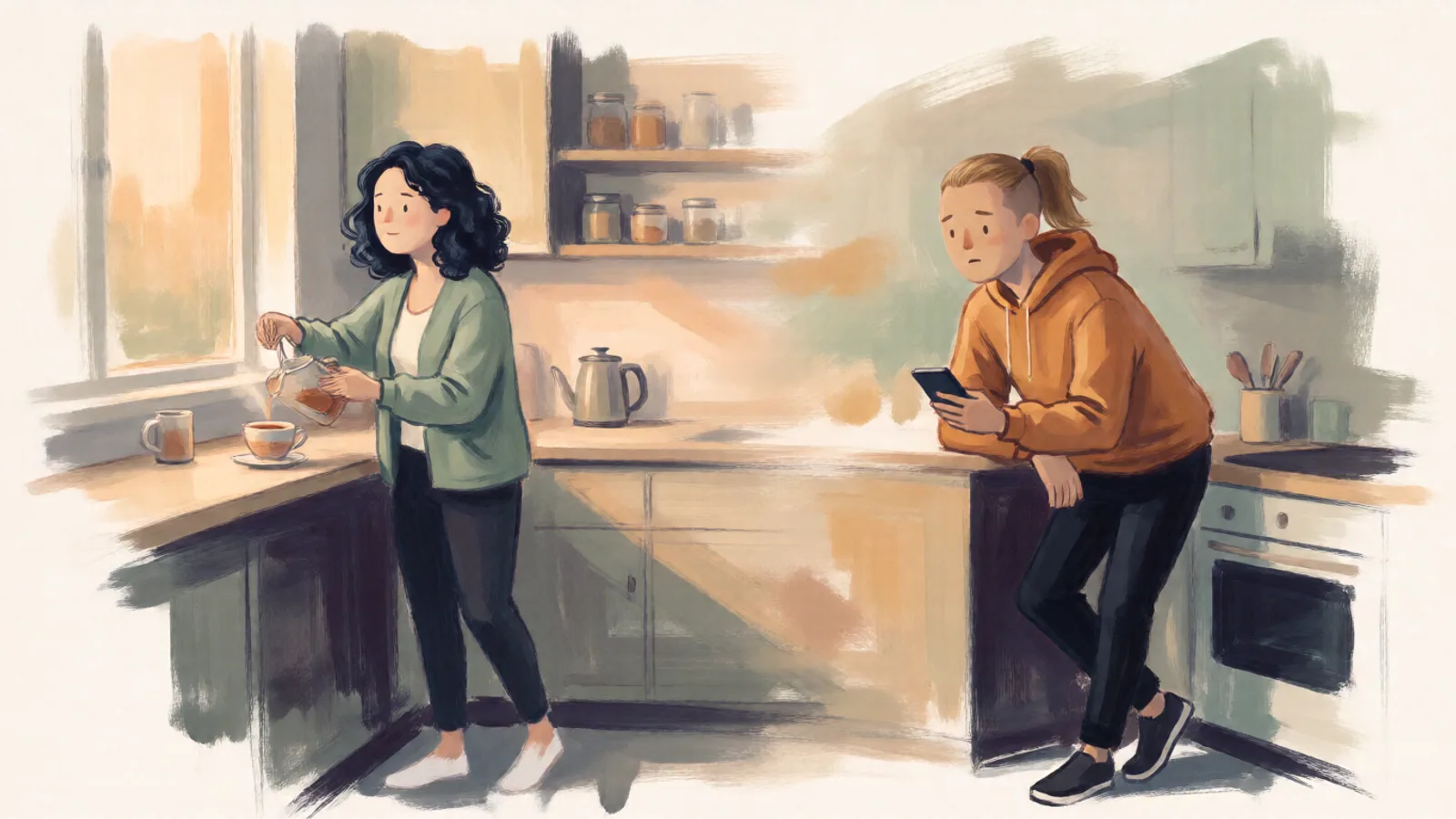
Tuesday, 1:05 pm, you: "hey how's your day going?" By 3:30 there's no reply and your mind is already writing explanations. At 3:31 you send: "sorry if i said something weird last night." At 4:10 they answer: "omg no, back-to-back meetings. why would you think that?"
Their reply is honest. To you it can still feel like proof you were "too much" again. To them, the apology for nothing reads as a puzzle. Do that a few times a week and it turns into a small, steady tax on their patience.
The arguments
They forgot the dinner reservation. You say, "it's fine," then go quiet. An hour later: "I just think if it mattered to you, you'd have remembered." They say, "I'm sorry, I messed up. Want to rebook for Friday?" You hear it as too easy and push for more: "that's it?"
Researchers describe a demand/withdraw loop, where one partner presses with complaints and criticism and the other retreats [5]. A secure partner usually won't retreat early. But if every repair gets turned into a referendum on whether they love you, even a steady person eventually starts walking on eggshells, and that wariness then looks to you like the distance you feared.
The distance
They want a weekend away with friends. They mention it on Wednesday and offer to send photos. You say "of course, have fun," then spend Saturday refreshing their story, counting how long it takes them to reply, and quietly testing: "guess you're having too much fun to text 😅."
They come home happy and missed you. You come home to them already braced for a fight. They needed a weekend with friends. You needed proof you still mattered. Neither need is wrong. The trouble is that you went looking for proof instead of asking for contact.
What each of you needs
What you need Predictability you can see: a rough sense of when you'll hear from them, follow-through on plans, and plain words instead of hints. You need permission to ask for reassurance out loud without it being treated as a problem. And you need other sources of steadiness, like friends, routines and work that's yours, so one person isn't holding up your whole nervous system.
What they need Straight requests, not tests. Room to be off-grid for an afternoon without having to file a report. Their reassurance believed the first time, or at least the second. Repairs accepted when they're offered. And some sign that the relationship isn't a probation period they have to keep passing.
Survival strategies

- Name the alarm before you act on it. When the urge to text hits, write the message in your notes app, not the chat. Wait 20 minutes, then check whether it's a request or a test. A request asks for something. A test hopes they'll guess.
- Ask for the specific reassurance you want. Vague anxiety gets vague comfort. "Do you still like me?" is hard to answer well. "Can you text me when you land?" is easy to say yes to.
- Agree on a rhythm. Talk about contact on a calm day, not in the middle of a spiral. When do you usually check in? What does "busy" look like? A shared baseline gives your alarm something to measure against besides your imagination.
- Let the repair land. When they apologise and offer a fix, say yes to the fix. Notice that the conflict ended and they're still there. Each time that happens, it adds to the evidence your system needs.
- Build a second and third anchor. Book the friend dinner for the same weekend they're away. Keep the gym class. Your steadiness shouldn't depend only on their phone.
- Track the pattern, not the moment. Once a month, ask yourself whether they've been steady. If the answer keeps being yes, let it count. In one study of newlyweds, people became more secure on average over the first years [4], but your system has to actually update on what it sees.
Scripts you can use:
hey, my brain's doing the thing where a slow reply feels like something's wrong. nothing you did. a quick "all good" would help a lot
I'm not upset about the reservation. I think I panicked that it meant something bigger. Friday works. I'm in.
can we agree on a loose check-in for when you're away? like one text at night. it'll stop me spiralling and you won't get the 2pm "you ok??"
When it works
It's a Saturday and they still haven't called at 10:20. You notice the tightness, label it as old wiring, and make coffee. They call at 10:45, out of breath, and it's just a phone call.
When this pairing works, it looks ordinary in the best way. You ask, they answer. They leave for the weekend, you get your goodnight text, and you actually enjoy your own Saturday. Arguments end with a plan instead of a verdict. Over months, the spaces between spirals get longer. Research suggests attachment and the relationship shape each other over time [4], and that how the relationship actually feels day to day predicts quality far more than anyone's style label does [6]. You don't need to become secure first. You need to keep noticing that this is safe.
Red flags it isn't working

- You've had the same "you never reassure me" argument for months, and both of you leave it feeling worse.
- They've started over-explaining every plan in advance to avoid your reaction, and you've noticed they seem tired.
- Their steadiness has turned into flatness: they don't follow through, don't initiate, and call your basic requests "drama."
- You feel calmer when they're away than when they're with you, and it isn't because you've grown.
- You keep turning the relationship into a test you're hoping they'll fail, so you can stop waiting for the drop.
Some of these are yours to work on. Some point to a mismatch that steadiness can't fix. Which ones they are, and what you do about them, including whether you stay, is your call to make.
Sources (6)
- Fraley, R. C. A Brief Overview of Adult Attachment Theory and Research. University of Illinois. https://labs.psychology.illinois.edu/~rcfraley/attachment.htm (accessed 2026-10-05)
- Bartholomew, K., & Horowitz, L. M. (1991). Attachment styles among young adults: A test of a four-category model. Journal of Personality and Social Psychology, 61(2), 226–244. https://doi.org/10.1037/0022-3514.61.2.226 (abstract; accessed 2026-10-05)
- Simpson, J. A., & Overall, N. C. (2014). Partner buffering of attachment insecurity. Current Directions in Psychological Science, 23(1), 54–59. https://doi.org/10.1177/0963721413510933 (abstract; accessed 2026-10-05)
- Davila, J., Karney, B. R., & Bradbury, T. N. (1999). Attachment change processes in the early years of marriage. Journal of Personality and Social Psychology, 76(5), 783–802. https://doi.org/10.1037/0022-3514.76.5.783 (abstract; accessed 2026-10-05)
- Christensen, A., & Heavey, C. L. (1990). Gender and social structure in the demand/withdraw pattern of marital conflict. Journal of Personality and Social Psychology, 59(1), 73–81. https://doi.org/10.1037/0022-3514.59.1.73 (abstract; accessed 2026-10-05)
- Joel, S., Eastwick, P. W., et al. (2020). Machine learning uncovers the most robust self-report predictors of relationship quality across 43 longitudinal couples studies. PNAS, 117(32), 19061–19071. https://doi.org/10.1073/pnas.1917036117 (abstract; accessed 2026-10-05)
Keep going
Fearful-Avoidant With a Secure Partner: The Survival Guide
Their steadiness is what you wanted, and it is also what scares you. How to stop testing a partner who keeps passing, and let calm be real.
Why: hand-picked as a companion
Secure With a Secure Partner: The Survival Guide
Two secure partners start with an advantage, not a guarantee. How to keep the calm from turning into coasting, with scripts for the slow…
Why: hand-picked as a companion
Secure With an Anxious Partner: The Survival Guide
You can be the steady one without becoming the only calm in the room. How to love an anxious partner and keep your own limits.
Why: hand-picked as a companion
More like this
- Guide Dismissive-Avoidant With a Secure Partner: The Survival Guide
- Guide Anxious With an Anxious Partner: The Survival Guide
- Quiz What's your attachment style?
- Guide Anxious With a Dismissive-Avoidant Partner: The Survival Guide
- Guide Anxious With a Fearful-Avoidant Partner: The Survival Guide
- Quiz What's your texting-era attachment energy?
- Term Self-abandonment
- Article Protest behaviour: what it is and why you did it
- Term Protest behaviour