
Chapter 6 of 8
Anxious With a Fearful-Avoidant Partner: The Survival Guide
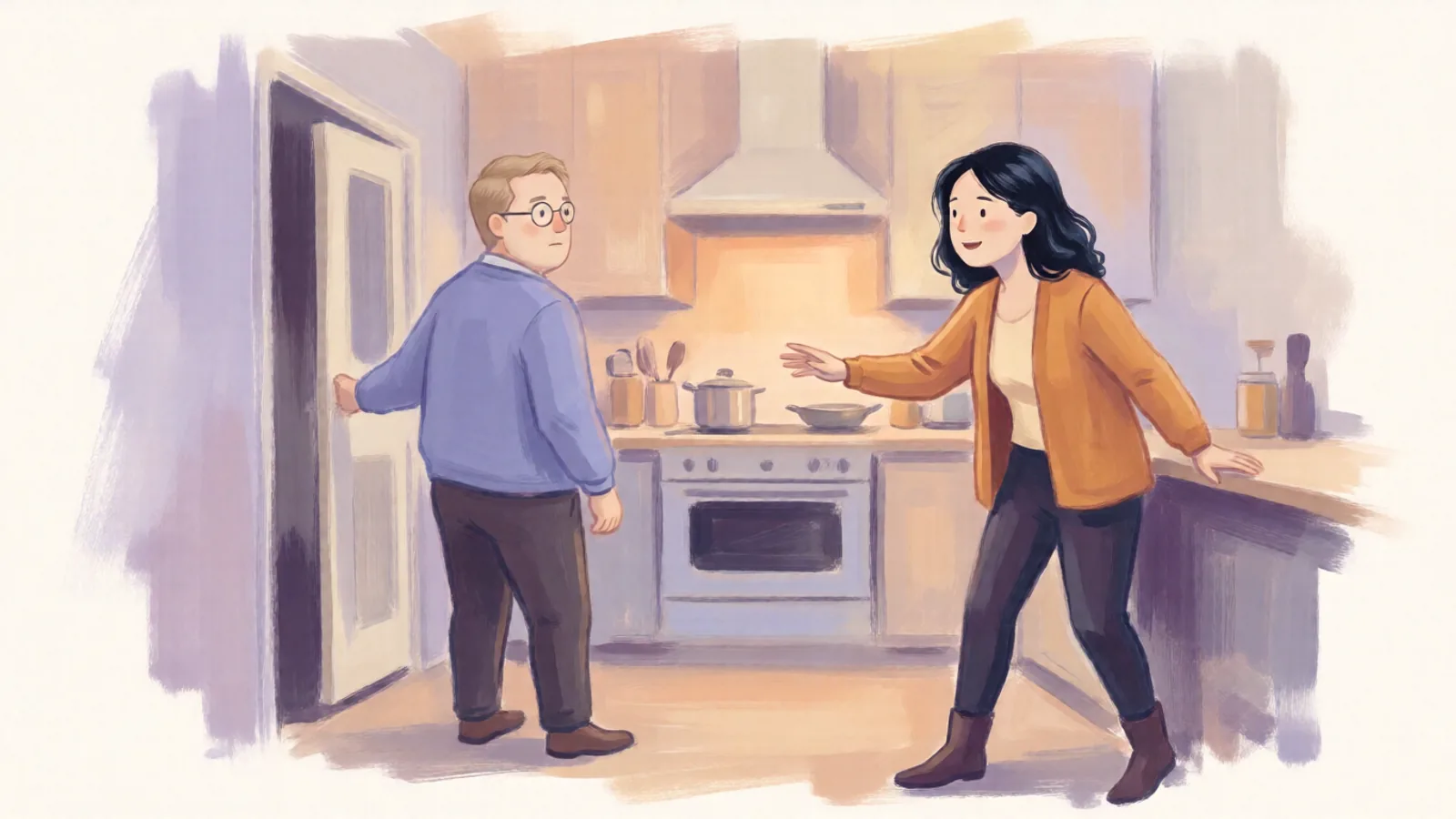
Saturday night they said they'd never felt this close to anyone. They asked about your childhood. They made plans for spring. It's now Monday, 4:12 p.m., and your "good morning" from 8:03 is still on delivered. You're rereading Saturday for the moment it went wrong. There wasn't one. The closeness was the moment.
This guide is about that swing: why it happens, why it hits you so hard, and what you can do and say when it starts again.
How you're each wired
Attachment styles aren't boxes. Researchers describe them as two sliding scales: how much you worry about being left (anxiety) and how uncomfortable you are with closeness (avoidance) [1]. You sit high on the first and low on the second. Your partner sits high on both. That overlap matters: you share the fear of being left. You just handle it in opposite ways.
You: Anxious (preoccupied) When you sense distance, your system turns up. You notice the shorter reply, the missing emoji, the slower response. You move closer: text, ask, reassure, fix. Researchers call this a hyperactivating strategy, keeping the attachment alarm switched on so you don't miss a threat [4]. It calms down with proof: a reply, a plan, a plain "we're good".
Them: Fearful-avoidant Your partner runs both strategies at once. Bartholomew described fearful avoidance as wanting contact but being held back by fear of what it will cost [2]. People in this pattern often hold a shaky view of themselves and a wary view of others [3]. So closeness feels good, then exposed. Distance feels safe, then lonely. Levine's popular framing calls this oscillation: swinging between pulling people close and pushing them away [6]. It isn't a lack of feeling. If anything, there's a lot of it, pulling in two directions.
What draws you together
At the start, this pairing can feel like the most intense connection you've had. A fearful-avoidant partner doesn't hold back in the early weeks the way someone who leans dismissive might. They're open, warm and hungry for closeness, because they want it too [2]. You finally feel met. They feel wanted. There's often a sense of recognition: you both know what it's like to fear losing someone.
Be honest about the other part of the pull, though. The highs feel bigger because of the lows around them. When a pattern runs on relief, relief starts to feel like love. That's not proof the relationship is wrong. It's a reason to look past the intensity at what happens day to day.
Where it goes wrong
The texts

Thursday, 10:47 p.m., after a long call: "i don't know what i did to deserve you." Friday, 9:15 a.m., you send: "still thinking about last night 🥹". Nothing. 1:30 p.m.: "hey you ok?" 6:40 p.m.: "did i say something wrong?" At 11:58 p.m. they reply: "sorry, been a lot today."
From your side, the warmth vanished overnight and you need to know why. From theirs, Thursday felt so open that Friday felt dangerous. Each follow-up text is another reminder of how much you need them, which is exactly the feeling they're backing away from. Your pursuit felt good on Thursday. By Friday evening it feels like pressure.
The arguments
This loop doesn't always run in one direction. You raise it on Sunday: "you go cold every time we get close and i never know why." They go quiet, or say "maybe i'm just not good at this." You push for an answer. They pull back further. That's the classic demand/withdraw pattern: one partner presses with requests and complaints, the other retreats [5].
But then the roles can flip. When you finally go quiet, they may panic and come after you, worried you're leaving. Research on demand/withdraw found people tend to press on the changes they want and retreat from the changes asked of them [5]. With a fearful-avoidant partner, both of you have something to press on, so the argument can feel like two people taking turns chasing.
The distance
You plan a weekend away. Two days before, they say they need to "see how work goes." The trip happens, and it's lovely, and on the drive home they're quiet. Then they cancel Wednesday dinner. A month later they bring up moving in together, and you feel the hope come back.
The distance here isn't steady, the way it might be with a dismissive partner. It comes and goes, often right after the best moments. That's what makes it so hard to read. You can't relax in the good stretches because you're waiting for the drop.
What each of you needs
What you need You need consistency more than intensity. Clear plans that happen. Replies on a rough but reliable rhythm. A partner who tells you when they need space instead of disappearing into it. You also need a way to calm your own alarm that doesn't depend on their next text, because in this pairing that text won't always come on time.
What they need They need closeness at a pace that doesn't flood them. They need to be able to step back for a day without it becoming a crisis, and to come back without a trial. They need to hear that you're not going anywhere, and to see it over time, because words alone may not reach the part of them that expects to be left. Their fear is real, even when the way it shows up hurts you.
Survival strategies

- Name the swing out loud, on a calm day. Not mid-silence. On a good evening, say what you notice: close, then cold, then back. Ask what the cold part feels like from inside. You're not labelling them. You're making the pattern something you can both point at.
- Agree on a "stepping back" signal. The silence hurts more than the space. Ask for a short message that says "i need a bit of room, i'm not going anywhere." Offer the same in return. A two-word text can save you a day of spiralling.
- Wait out the alarm before you reply. When the pull-back starts, give it two hours before you send anything. Use that time on something that steadies you: a walk, a friend, your own plans. One clear message beats five anxious ones.
- Don't chase the swing, and don't punish it. When they go cold, don't follow. When they come back warm, don't make them pay for the gap. Both moves widen the swing. Stay at your own steady level.
- Judge by the trend, not the day. Every three months, look at the pattern. Are the cold stretches getting shorter? Are plans kept more often? How the relationship actually feels over time predicts more than either of your styles [7].
- Decide what you'll do if nothing moves. You can't steady this alone. If the swing hasn't eased after you've both named it and tried, leaving is a clear, dignified choice. Not a threat, not a test. A decision.
When they go quiet after a close night:
hey, last night was really good. if you need some space today that's ok, just let me know you're alright
When the argument starts turning into a chase:
i'm not trying to corner you. i'm going to stop for tonight. can we talk tomorrow after dinner?
When you need to say what you need:
i can handle you needing space. what i can't handle is not knowing. a heads-up is all i'm asking for
When it works
When this pairing works, the swing doesn't vanish, but it shrinks. They still need a quiet day after a big weekend, and now they say so: "low battery, love you, talk tonight." You still feel the flicker of alarm, and now you notice it, text a friend, and let it pass. Plans get kept. Arguments end with "let's pick this up tomorrow" and actually get picked up.
Over time, steady relationships can move people toward security, and attachment and the relationship keep shaping each other [8]. Your consistency can show them closeness doesn't end in loss. Their honesty about space can show you that distance isn't always goodbye.
Red flags it isn't working
- You've named the hot-and-cold pattern several times, calmly, and it's still running at the same size.
- The silences keep happening with no signal, even after you asked for one and they agreed.
- You spend more of the relationship waiting for the next drop than enjoying where you are.
- Plans about the future keep appearing in the warm stretches and disappearing in the cold ones.
- You've stopped telling friends how you feel, because you know what they'll say.
If these sound familiar, you don't have to fix it by trying harder. You get to decide what you're available for.
Sources (8)
- Fraley, R. C. A Brief Overview of Adult Attachment Theory and Research. University of Illinois. https://labs.psychology.illinois.edu/~rcfraley/attachment.htm (accessed 2026-10-05)
- Bartholomew, K. (1990). Avoidance of intimacy: An attachment perspective. Journal of Social and Personal Relationships, 7(2), 147–178. https://doi.org/10.1177/0265407590072001 (abstract; accessed 2026-10-05)
- Bartholomew, K., & Horowitz, L. M. (1991). Attachment styles among young adults: A test of a four-category model. Journal of Personality and Social Psychology, 61(2), 226–244. https://doi.org/10.1037/0022-3514.61.2.226 (abstract; accessed 2026-10-05)
- Mikulincer, M., & Shaver, P. R. (2003). The attachment behavioral system in adulthood: Activation, psychodynamics, and interpersonal processes. Advances in Experimental Social Psychology, 35, 53–152. https://doi.org/10.1016/S0065-2601(03)01002-5 (metadata only; accessed 2026-10-05)
- Christensen, A., & Heavey, C. L. (1990). Gender and social structure in the demand/withdraw pattern of marital conflict. Journal of Personality and Social Psychology, 59(1), 73–81. https://doi.org/10.1037/0022-3514.59.1.73 (abstract; accessed 2026-10-05)
- Levine, A. Author website. https://www.amirlevinemd.com/ (accessed 2026-10-05)
- Joel, S., Eastwick, P. W., et al. (2020). Machine learning uncovers the most robust self-report predictors of relationship quality across 43 longitudinal couples studies. PNAS, 117(32), 19061–19071. https://doi.org/10.1073/pnas.1917036117 (abstract; accessed 2026-10-05)
- Davila, J., Karney, B. R., & Bradbury, T. N. (1999). Attachment change processes in the early years of marriage. Journal of Personality and Social Psychology, 76(5), 783–802. https://doi.org/10.1037/0022-3514.76.5.783 (abstract; accessed 2026-10-05)
Keep going
Fearful-Avoidant Push-Pull, for an Anxious Partner: The Survival Guide
They pull you close, end it in tears, then come back weeks later. Why this fast cycle grips an anxious partner, and how to get off it.
Why: hand-picked as a companion
Anxious With a Dismissive-Avoidant Partner: The Survival Guide
The more you reach, the more they pull back. Why the anxious-avoidant loop runs, what each of you needs, and how to step out of the chase.
Why: hand-picked as a companion
Anxious With an Anxious Partner: The Survival Guide
Two people who both reach. It can feel like finally being met, until both alarms go off at once. How to keep the closeness and calm the…
Why: hand-picked as a companion
More like this
- Guide Dismissive-Avoidant Push-Pull, for an Anxious Partner: The Survival Guide
- Guide Dismissive-Avoidant With a Fearful-Avoidant Partner: The Survival Guide
- Guide Fearful-Avoidant Push-Pull, for a Dismissive Partner: The Survival Guide
- Guide Fearful-Avoidant Push-Pull, for a Fearful-Avoidant Partner: The Guide
- Guide Fearful-Avoidant Push-Pull, for a Secure Partner: The Survival Guide
- Guide Fearful-Avoidant With a Fearful-Avoidant Partner: The Survival Guide
- Guide Secure With a Fearful-Avoidant Partner: The Survival Guide
- Quiz Is your ex an avoidant?
- Term Hot and cold (push-pull)