
Chapter 7 of 8 · Back to push-pull
Fearful-Avoidant Push-Pull, for a Dismissive Partner: The Survival Guide
Sunday, 11:52pm: "i think we should stop. i'm sorry." You read it twice, type "ok. take care of yourself," and go to sleep. Monday is quiet. You feel lighter, almost. Thursday, 1:14am: "i can't stop thinking about you. can i come over?" You say yes, because it's easy, and because nothing about Sunday ever felt fully real.
You're not the one who panics in this cycle. That's exactly why it can run for months around you. This guide shows how the fast push-pull works, why your calm keeps it turning, and how to end it on purpose instead of by default.
What the cycle looks like
The pull
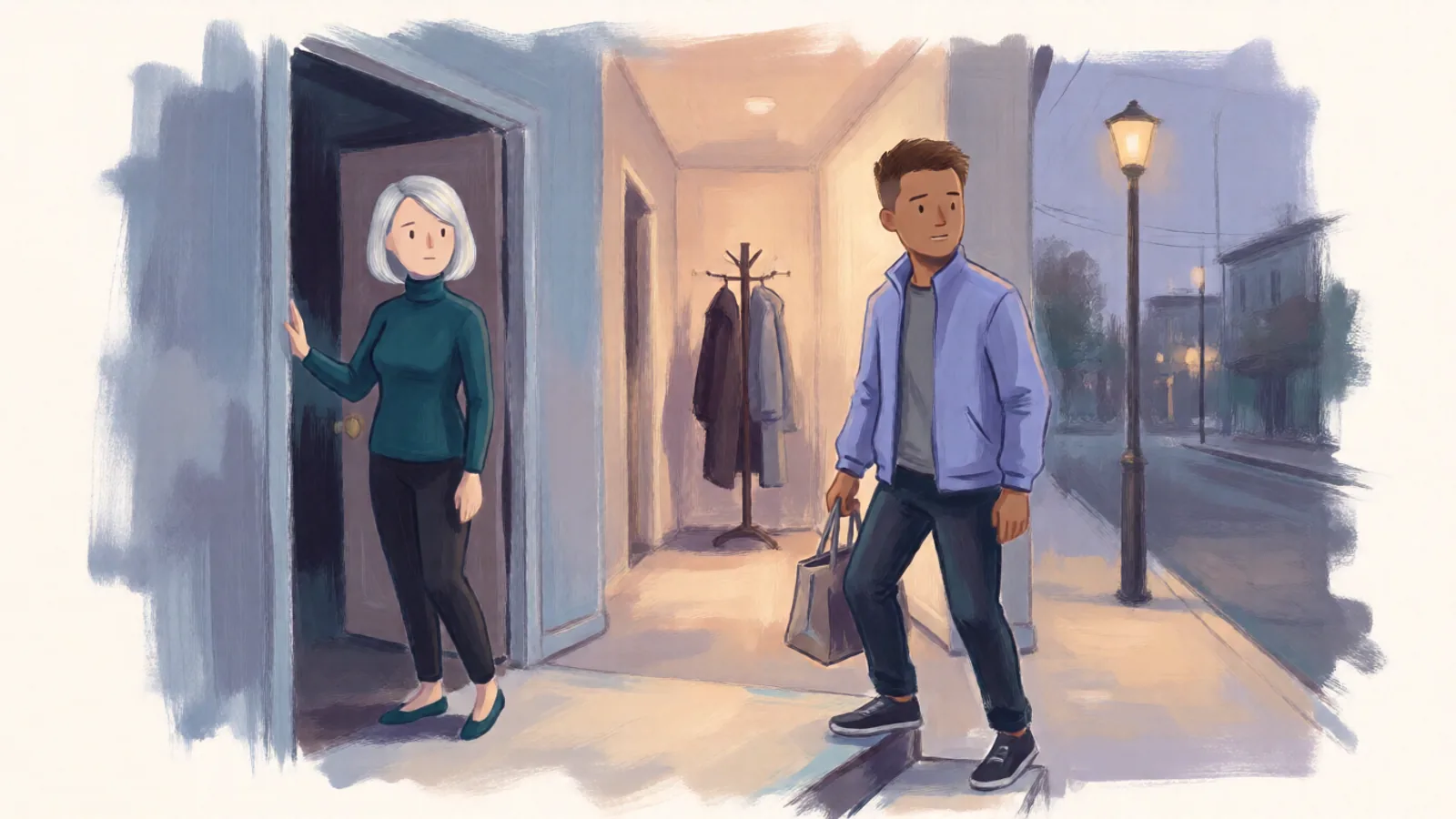
They come back hot. Not a casual "hey", but a long message at 1am, then a visit where they talk fast and touch your arm a lot. "i was so stupid. i don't know why i do this. you're the only person i feel calm with." For a week it's intense: daily calls, plans for a trip, a key to their place. You enjoy it, mostly. Part of you is already counting how much room you'll get back when it stops, and part of you likes being the calm one they run to.
The push
Then something small tips it. You take a night to yourself, or you don't say "I love you" back on cue, or things just get close enough to frighten them. Wednesday, 6:10pm: "are we ok?" You reply at 9: "yeah, why?" By Friday the texts are short. Saturday: "i need to end this. it's not you, i just can't." There are tears on the phone, theirs, and real distress. You stay level, say you understand, and hang up feeling a mix of relief and something flat you'd rather not inspect.
The timeline
Real cycles vary in speed and shape. A typical run looks like this:
- Week 1: The pull. They're back, warm and urgent. Daily contact, big plans, "this time is different."
- Week 2: Closeness peaks. You step back a little to breathe. They notice, and start checking: "are we ok?"
- Week 3: The push. Short replies, a cancelled dinner, then the breakup by text or a tearful call on Saturday night.
- Week 4: The return, four days after the breakup. A 1am message, a "can we talk", a visit. You agree without asking what changed.
- Weeks 5-8: The same loop again, a little faster. You stop telling friends about the breakups because it's tiring to explain.
Why your partner does this
The engine is two strong pulls running at the same time. One early account describes fearful avoidance as a conscious wish for closeness held back by fear of what closeness will cost [1]. In the four-style model, that pattern pairs a shakier view of oneself with a guarded view of others [2]. So when things get close, the fear rises, and leaving first feels safer than waiting to be left. Once they're out, the fear of losing you takes over, and they come back. Both moves are real. Neither is a performance.
You'll see this called "disorganized" attachment online. That word comes from research on infants, and it's popular shorthand here, not settled science: researchers who study it say there is "as yet little evidence" that the infant category and adult self-report styles refer to the same thing [3]. Treat it as a pattern your partner runs under pressure, not a label for who they are.
Why it hooks you

Your strategy is the opposite of chasing. When closeness rises, your system turns the need down. Researchers call this deactivating [7]. After a breakup, people who lean avoidant tend to cope alone and show less distress and less effort to win the partner back [4]. That sounds like protection, and in some ways it is. You don't fall apart on Saturday.
But look at what your calm does inside this cycle. Each breakup ends with no argument, no clear reason and no shared decision. On-off research finds that renewals are more likely when people are unsure what the breakup meant, and that lingering feelings are the main reason partners come back; breakups both people decide on go with fewer renewals [5]. Your "ok, take care" leaves every ending open. The push also gives you something you quietly want, room, so it never costs enough for you to stop it. And the return asks nothing of you except yes. The cycle is easy for you in each moment and expensive over months. You tend to notice the cost late, all at once.
Surviving a push phase
When they pull away or break it off, your instinct is to accept it cleanly and go quiet. That's fine for the first night. The problem is the next step: you leave the ending undefined, and undefined endings come back around.
So use the space, but decide something inside it. Give yourself three or four days before you reply to anything beyond logistics. Then ask yourself one question: if this were the last breakup, would I be all right with that? If the answer is yes, say so. If it's no, say that. Either way, don't let "ok" be your whole contribution. Notice, too, if the relief you feel is bigger than the sadness. That's information about you, not proof about them.
i hear you. i'm not going to argue. i do need to know if this is a real ending or a pause, because i'm not doing the in-between again.
Surviving a pull phase
When they come back, you'll want to skip the conversation. It feels like drama, and the warm version of them is pleasant to be around. Skipping it is how the cycle restarts.
Before you say yes, ask two plain questions: what happened, and what's different now? You're not asking for a promise, which nobody can keep. You're checking whether either of you has a plan for the next time it gets close. Also tell the truth about your part. If you went quiet in week two, say so. Fairness here costs you little and gives the conversation somewhere to go.
i'm glad you reached out. before we pick back up: what made you leave last time, and what happens next time it gets close? i'll tell you my part too.
Getting off the cycle
On-off research suggests two things keep cycles going: uncertainty about whether it's over, and contact after the breakup that keeps the door open [6]. Clear endings both people agree on make a return less likely [5]. You don't control their fear. You do control how open you leave the door.
- Pick your answer before the next push. On a calm day, decide what you'll do the next time they end it: is it one more try with a real conversation, or the last time? Decide while you're steady, not at 1am.
- Set one boundary about returns, and name it as a boundary. For example: the next breakup is final. Say it once, in a calm moment, not as a threat during a fight.
- Make the ending mutual and spoken. If it ends, say what it is, together if possible. "We're done, and I'm not going to reopen it" is clearer than "ok."
- Cut the in-between contact. No late-night calls "just to check in", no sleeping together after the breakup. Those are the threads a return runs along.
- Watch your own exit. If you're the one ending it, be honest that some of it is relief. That's allowed. Just make sure you're choosing, not drifting.
this is a boundary for me: if we break up again, it's the last time. i'm saying it now so it's not a surprise later.
i care about you, and i meant what i said. i'm not getting back together. please don't message me late at night.
None of this guarantees they'll change, or that they'll stay gone. It means the cycle stops depending on your silence.
When to step off for good
- You've been through three or more breakups and returns, and no one has ever said what caused them.
- You've stopped telling friends about the breakups because you're tired of explaining, or embarrassed.
- You notice you're more relieved when they leave than glad when they come back.
- You've asked the two questions and named the boundary, and the cycle hasn't slowed down.
If those are true, you're allowed to stop. Leaving because you're done is a clear, decent choice, not a failure of warmth. Make it on purpose, and say it out loud.
Sources (7)
- Bartholomew, K. (1990). Avoidance of intimacy: An attachment perspective. Journal of Social and Personal Relationships, 7(2), 147–178. https://doi.org/10.1177/0265407590072001 (abstract; accessed 2026-10-05)
- Bartholomew, K., & Horowitz, L. M. (1991). Attachment styles among young adults: A test of a four-category model. Journal of Personality and Social Psychology, 61(2), 226–244. https://doi.org/10.1037/0022-3514.61.2.226 (abstract; accessed 2026-10-05)
- Granqvist, P., Sroufe, L. A., Dozier, M., Hesse, E., Steele, M., van IJzendoorn, M., Solomon, J., ... Duschinsky, R. (2017). Disorganized attachment in infancy: A review of the phenomenon and its implications for clinicians and policy-makers. Attachment & Human Development, 19(6), 534–558. https://doi.org/10.1080/14616734.2017.1354040 (accessed 2026-10-05)
- Davis, D., Shaver, P. R., & Vernon, M. L. (2003). Physical, emotional, and behavioral reactions to breaking up: The roles of gender, age, emotional involvement, and attachment style. Personality and Social Psychology Bulletin, 29(7), 871–884. https://doi.org/10.1177/0146167203029007006 (abstract; accessed 2026-10-05)
- Dailey, R. M., Jin, B., Pfiester, A., & Beck, G. (2011). On-again/off-again dating relationships: What keeps partners coming back? The Journal of Social Psychology, 151(4), 417–440. https://doi.org/10.1080/00224545.2010.503249 (abstract; accessed 2026-10-05)
- Dailey, R. M., Rossetto, K. R., Pfiester, A., & Surra, C. A. (2009). A qualitative analysis of on-again/off-again romantic relationships: "It's up and down, all around." Journal of Social and Personal Relationships, 26(4), 443–466. https://doi.org/10.1177/0265407509351035 (abstract; accessed 2026-10-05)
- Mikulincer, M., & Shaver, P. R. (2003). The attachment behavioral system in adulthood: Activation, psychodynamics, and interpersonal processes. Advances in Experimental Social Psychology, 35, 53–152. https://doi.org/10.1016/S0065-2601(03)01002-5 (metadata only; cited for the term "deactivating"; accessed 2026-10-05)
Keep going
Dismissive-Avoidant With a Fearful-Avoidant Partner: The Survival Guide
You both pull away when it gets intense, for different reasons. Here is how the drift happens and how to say what you want before it stalls.
Why: hand-picked as a companion
Fearful-Avoidant Push-Pull, for a Fearful-Avoidant Partner: The Guide
Your partner breaks it off and comes back, fast and hot, and you know the cycle from the inside. How to stop running it with them.
Why: hand-picked as a companion
The Push-Pull Cycle: Why Some Relationships Keep Ending and Restarting
Why some couples break up and get back together again and again: the fast fearful-avoidant cycle, the slow dismissive fade and return, and…
Why: hand-picked as a companion
More like this
- Guide Dismissive-Avoidant Push-Pull, for a Dismissive-Avoidant Partner: The Guide
- Guide Anxious With a Fearful-Avoidant Partner: The Survival Guide
- Guide Fearful-Avoidant Push-Pull, for an Anxious Partner: The Survival Guide
- Guide Fearful-Avoidant Push-Pull, for a Secure Partner: The Survival Guide
- Guide Fearful-Avoidant With a Fearful-Avoidant Partner: The Survival Guide
- Guide Secure With a Fearful-Avoidant Partner: The Survival Guide
- Quiz Is your ex an avoidant?
- Term Hot and cold (push-pull)
- Guide Dismissive-Avoidant Push-Pull, for a Fearful-Avoidant Partner: Survival Guide