
Chapter 7 of 8 · Back to push-pull
Dismissive-Avoidant Push-Pull, for an Anxious Partner: The Survival Guide
It's a Tuesday in March, 9:40 p.m. Your phone lights up with a name you stopped checking for around Christmas. "hey. saw a dog that looked exactly like yours today. hope you're good." No apology. No mention of the three weeks of one-word replies, or the night they said "i just don't think i can give you what you want right now" and then went quiet for four months.
Your heart is already writing back. This guide is about that moment: the slow fade, the long silence and the easy return, why it lands so hard on an anxious heart, and how to stop the cycle from deciding for you.
What the cycle looks like
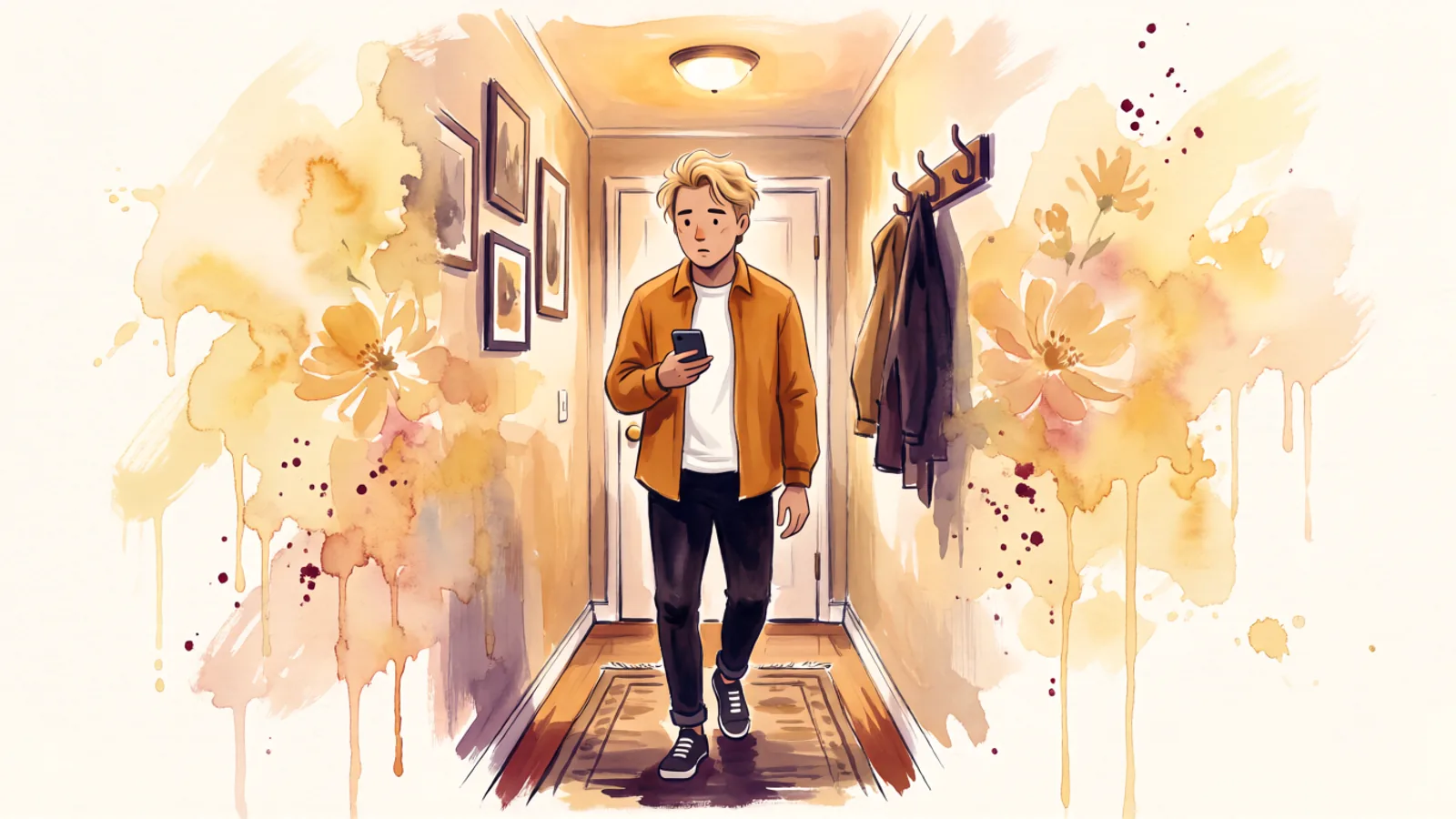
This isn't the fast, stormy version of push-pull, with tearful breakups and 2 a.m. reunions inside the same month. That's the fearful-avoidant pattern, and it has its own guide. This one is cooler and slower. Nobody slams a door. The door just drifts shut, and months later someone knocks like they only stepped out for milk.
The pull
The pull is calm and easy, which is part of why it works. They're funny, steady, present. Saturday turns into Sunday. They text "you around? want to get food" at 6:15 p.m. on a weeknight and it feels effortless. When they come back after a long gap, it's low-key: "hey stranger", a meme, a question about your sister's wedding. No big speech, no talk about what happened. You tell yourself the time apart must have helped them figure it out, and that this time feels different because it's so relaxed.
The push
The push usually starts right after something gets closer: meeting their friends, a weekend away, you saying "so what are we?" The texts don't stop. They thin out. "haha yeah" at 11:52 p.m. to a message you sent at 2 p.m. Plans become "let's see how the week goes." When you ask, they're calm, almost kind: "nothing's wrong, i've just got a lot on." The ending, if there is one, is brief and soft: "i think i need some space. i'm not in a place for something serious." Then very little. They don't argue, and they don't chase. To you it looks like they've stopped caring. From the inside it may look more like relief.
The timeline
Real cycles vary a lot. This is one common shape, not a rule.
- Weeks 1-8: The pull. Easy, warm, regular plans. You meet their friends in week 6.
- Weeks 9-11: The fade. Replies slow, weekends get vague, you ask what's going on and hear "nothing, just busy."
- Week 12: The breakup, such as it is: a short "i need space" call, or no call at all, just silence you eventually name as an ending.
- Months 4-5: Nothing. You check their profiles, draft texts, delete them.
- Month 6: They reach out: "hey, been thinking about you." It's warm again within days, and nobody talks about the fade.
- Months 8-9: Something gets close again, and the replies start thinning.
Why your partner does this

Researchers describe the dismissing pattern as a "defensive denial of the need or desire for greater social contact" [1]. That's not the same as having no need. It's a strategy of turning attachment needs down, which researchers call deactivating [2]. When closeness or commitment rises, the strategy kicks in: less contact, more self-reliance, more distance. The strategy shows up in breakups too. In a large survey of people reflecting on breakups, higher avoidance went with less distress and less effort to win the partner back, and with coping alone [3]. That fits why the push is so quiet.
The return is harder to explain, and no study has measured it for this pattern. One six-month study found people longed more for an ex when their current relationship got worse [4], and on-off research finds that lingering feelings are the main reason partners renew [5]. Put together, one plausible story: once distance has lowered the pressure, or life has gone flat, the old relationship looks good again. Treat that as a recognisable story, not a finding.
Why it hooks you
An anxious strategy does the opposite of theirs. It turns attachment needs up: more monitoring, more reaching, more reading of every reply [2]. In the breakup survey, higher attachment anxiety went with more preoccupation with the lost partner, more distress and more attempts to get the relationship back [3]. So the same silence lands very differently in the two chairs. For them, the push is a relief valve. For you, it's an alarm that won't switch off.
The slow pace makes it worse. A fast cycle at least gives you answers. This one gives you months of nothing, and nothing is where an anxious mind does its hardest work: replaying the last call, wondering what you did, wondering if it's really over. On-off research finds that uncertainty about what a breakup meant makes a renewal more likely [5]. When the "hey" finally comes, it doesn't just feel nice. It feels like the alarm stopping. That relief is real, and it's also what keeps the loop running.
Surviving a push phase
When the replies start thinning, your instinct will be to close the gap: more texts, a "did i do something?", a long message at midnight. Don't. Chasing tends to speed up the fade, and it leaves you feeling worse about yourself whatever they answer.
Ask once, plainly, and then let their actions be the answer. Give yourself a time limit before you decide anything: a week of watching what they do, not what they say. Fill the gaps you were saving for them with people who reply. Mute their stories if checking them is how you spend your evenings. If they end it, softly or by silence, name it to yourself as an ending. You don't need their help to know what happened.
hey, i've noticed things have gone quiet. if you need space, say so and i'll give it. i'd rather know than guess.
Surviving a pull phase

When they come back, you're allowed to feel glad. You're not allowed to pretend the last fade didn't happen. The casual tone is an invitation to skip the conversation, and skipping it is how the next fade starts.
Before you say yes to dinner, ask the questions the return is built to avoid. What happened last time? What's different now? What would they do when things get close again? Listen for specifics, not mood. "I missed you" is a feeling. "I'd tell you when I need space instead of disappearing" is a plan. Then go slowly. Notice whether they're still here at the point where they left last time.
it's good to hear from you. before we pick back up, i need to talk about how it ended last time. i'm not doing the fade again.
Getting off the cycle
On-off research gives you two useful levers. Mutually initiated breakups made renewals less likely, and uncertainty about what the breakup meant made them more likely [5]. Contact after a breakup tends to keep the door open [6]. The cycle also tends to repeat: in one national U.S. sample, partners who had already cycled were more likely to cycle again, even after moving in or marrying [7].
- Make the ending clear, even if they won't. If they fade, send one message that names it as over. You don't need them to agree. You need the ending to stop being a question in your head.
- Set a contact boundary, and say it once. No "just checking in", no birthday texts, no liking their posts for a set time: three months, at least. That boundary is for you, not a test for them.
- Decide your answer to the next "hey" now, while you're calm, and write it in your notes app. If you would only consider trying again under certain conditions, write those down too.
- Keep living in the gap. See people, date if you want to, build the weeks around things that are yours. Renewals were more likely when people hadn't dated anyone else after the breakup [5].
i'm going to call this what it is: it's over. i'm not going to stay in touch for now. take care of yourself.
i'm glad you're ok. i'm not open to picking this back up.
Some on-off couples do settle into something stable [8]. If you do give it another try, make it a real conversation with real changes, not just the warm return. Whether it changes isn't something you can control. What you can control is whether you keep saying yes to the same shape.
When to step off for good

- You've been through the fade and the return two or more times, and nobody has ever talked about why.
- Each return starts warm and ends at the same point: right after things get close.
- You've started living your months around the possibility of a text.
- When you ask for clarity, the answer is always calm and never specific.
- You spend more of the relationship waiting than being in it.
None of this makes them a bad person, and none of it makes you too much. It means the pattern is costing you more than it gives. Leaving isn't a move to get them back. It's you deciding you're done waiting, and that's your call to make.
Sources (8)
- Bartholomew, K. (1990). Avoidance of intimacy: An attachment perspective. Journal of Social and Personal Relationships, 7(2), 147–178. https://doi.org/10.1177/0265407590072001 (abstract; accessed 2026-10-05)
- Mikulincer, M., & Shaver, P. R. (2003). The attachment behavioral system in adulthood: Activation, psychodynamics, and interpersonal processes. Advances in Experimental Social Psychology, 35, 53–152. https://doi.org/10.1016/S0065-2601(03)01002-5 (metadata only; accessed 2026-10-05)
- Davis, D., Shaver, P. R., & Vernon, M. L. (2003). Physical, emotional, and behavioral reactions to breaking up: The roles of gender, age, emotional involvement, and attachment style. Personality and Social Psychology Bulletin, 29(7), 871–884. https://doi.org/10.1177/0146167203029007006 (abstract; accessed 2026-10-05)
- Spielmann, S. S., Joel, S., MacDonald, G., & Kogan, A. (2013). Ex appeal: Current relationship quality and emotional attachment to ex-partners. Social Psychological and Personality Science, 4(2), 175–180. https://doi.org/10.1177/1948550612448198 (abstract; accessed 2026-10-05)
- Dailey, R. M., Jin, B., Pfiester, A., & Beck, G. (2011). On-again/off-again dating relationships: What keeps partners coming back? The Journal of Social Psychology, 151(4), 417–440. https://doi.org/10.1080/00224545.2010.503249 (abstract; accessed 2026-10-05)
- Dailey, R. M., Rossetto, K. R., Pfiester, A., & Surra, C. A. (2009). A qualitative analysis of on-again/off-again romantic relationships: "It's up and down, all around." Journal of Social and Personal Relationships, 26(4), 443–466. https://doi.org/10.1177/0265407509351035 (abstract; accessed 2026-10-05)
- Vennum, A., Lindstrom, R., Monk, J. K., & Adams, R. (2014). "It's complicated": The continuity and correlates of cycling in cohabiting and marital relationships. Journal of Social and Personal Relationships, 31(3), 410–430. https://doi.org/10.1177/0265407513501987 (abstract; accessed 2026-10-05)
- Dailey, R. M., Middleton, A. V., & Green, E. W. (2012). Perceived relational stability in on-again/off-again relationships. Journal of Social and Personal Relationships, 29(1), 52–76. https://doi.org/10.1177/0265407511420192 (abstract; accessed 2026-10-05)
Keep going
Anxious With a Dismissive-Avoidant Partner: The Survival Guide
The more you reach, the more they pull back. Why the anxious-avoidant loop runs, what each of you needs, and how to step out of the chase.
Why: hand-picked as a companion
The Push-Pull Cycle: Why Some Relationships Keep Ending and Restarting
Why some couples break up and get back together again and again: the fast fearful-avoidant cycle, the slow dismissive fade and return, and…
Why: hand-picked as a companion
Fearful-Avoidant Push-Pull, for an Anxious Partner: The Survival Guide
They pull you close, end it in tears, then come back weeks later. Why this fast cycle grips an anxious partner, and how to get off it.
Why: hand-picked as a companion
More like this
- Article Protest behaviour: what it is and why you did it
- Guide Anxious With a Fearful-Avoidant Partner: The Survival Guide
- Guide Dismissive-Avoidant Push-Pull, for a Dismissive-Avoidant Partner: The Guide
- Guide Dismissive-Avoidant Push-Pull, for a Fearful-Avoidant Partner: Survival Guide
- Guide Dismissive-Avoidant Push-Pull, for a Secure Partner: The Survival Guide
- Guide Dismissive-Avoidant With a Dismissive-Avoidant Partner: The Survival Guide
- Guide Fearful-Avoidant With a Dismissive-Avoidant Partner: The Survival Guide
- Guide Secure With a Dismissive-Avoidant Partner: The Survival Guide
- Quiz Is your ex an avoidant?