
Article
Avoidant Red Flags: Signs of an Avoidant Partner
Someone is warm on Tuesday and unreachable by Friday. They say they like a person and then avoid the plan that would make it real. They go quiet after a good weekend. Anyone who has lived through this ends up searching the same few phrases: signs of an avoidant partner, signs of avoidant attachment, avoidant red flags.
This article lists the signs that attachment researchers and popular writers describe, split by stage: early dating, a longer relationship, and the two avoidant patterns. It also covers how to tell avoidance from anxiety, what looks like avoidance but isn't, and what the research can honestly say. It describes behaviour, not people. A sign is a pattern to notice, not a verdict.
What the signs of avoidant attachment are

In attachment research, avoidance is one of two main dimensions. The other is anxiety. Researchers who factor-analysed the self-report measures found these two broad factors, and describe adult attachment as two sliding scales more than four boxes [5]. Avoidance is the scale that runs from comfortable with closeness to uncomfortable with it.
Higher on the avoidance scale tends to look like this: a strong preference for self-reliance, discomfort with emotional intimacy, and a habit of playing down attachment needs. Mikulincer and Shaver call the underlying moves deactivating strategies. These are ways of turning attachment needs and feelings down when closeness rises [3]. The avoidant deactivation article goes through them one by one, and the glossary entry on deactivating strategies gives the short version.
So the signs below are not a list of faults. Each one is a way of managing closeness that feels like too much. They matter because the person on the other side often experiences them as rejection.
Signs of avoidant attachment in early dating
Early dating is where avoidance is easiest to miss, because new relationships are low in demand. The signs tend to show up when things start to get real.
- Fast warmth, then a step back. A great first few dates, followed by a day or three of silence, then a friendly message as if nothing happened.
- Plans stay vague. Interest is clear, but anything more than a few days ahead gets "let's see."
- Texting is uneven. Long gaps, short replies, and attention that arrives in bursts. This is sometimes called hot and cold.
- Talk stays on the surface. Plenty of humour and plans for the weekend, little about feelings, family or what the person wants.
- Mixed messages about the label. Affection without a name for it, and a change of subject when the question comes up.
- Independence is announced early. Statements like "I need a lot of space" or "I've never been good at relationships," said as facts rather than as a conversation.
- Pulling away after progress. A first overnight stay, a "meet my friends" invitation or a compliment can be followed by distance.
One sign proves nothing. Busy people go quiet, and cautious people go slowly. The pattern across several weeks, especially a pull-back after each step closer, says more than any single moment.
Signs in a longer relationship

Once a relationship has settled, avoidance often looks less like silence and more like a ceiling on how close things get.
- Feelings are shut down in conflict. Conversations that become heated end with leaving the room, going quiet or changing the topic. Researchers call the pairing of one partner pressing and the other retreating the demand/withdraw pattern, and one study of dating couples found avoidant men were rated less warm and supportive when discussing a major problem [4].
- Needs are minimised. "It's not a big deal," "you're overthinking it," or a joke where a conversation was wanted.
- Closeness has a limit. Warm on holidays and weekends, but a clear no to deeper steps such as moving in, sharing finances or meeting family.
- Independence defends against dependence. Refusing help, not asking for support, and treating the other person's need as pressure.
- Distance follows closeness. After an intense, connected stretch comes a cooler one. This is the loop described in the push-pull cycle.
- Small criticisms of the other person. Attention drifts to flaws, habits and imagined incompatibilities, which makes distance feel justified. Attachment writers often link this to deactivation, though it is a description, not a measured finding.
- Little talk of the future. The relationship exists in the present tense.
The glossary entry on being emotionally unavailable describes the felt result of these signs, which is a relationship that feels one-sided.
Signs of avoidant attachment in men
People search for "signs of avoidant attachment in men" because the cultural picture of avoidance is often male: the guarded, self-sufficient partner. Two points are worth separating.
First, the signs above are the same for anyone. Attachment avoidance is measured on the same scales for men, women and everyone else, and nothing in the research says the behaviour changes with gender.
Second, the stereotype has some basis in one sample. In a study of heterosexual dating couples, more avoidant men were rated as less warm and supportive when the couple discussed a major problem [4]. That is one sample from 1996, not a rule. Cultural expectations about men not showing emotion can also look like avoidance, or hide it. A man who learned to keep feelings to himself is not necessarily avoidant in the attachment sense. A man who is warm in most settings, and withdraws only when the relationship asks for deeper closeness, fits the attachment pattern better.
What the signs look like in practice: jokes in place of feelings, practical help in place of emotional talk, resistance to being "managed," and a tendency to go to work, the gym or friends when things get tense.
Dismissive or fearful: two sets of signs

Two different patterns both get called avoidant. Bartholomew described dismissing avoidance as "a defensive denial of the need or desire for greater social contact", and fearful avoidance as a conscious desire for contact that is inhibited by fear of its consequences [1]. The four-category model behind these names combines a view of the self with a view of others [2].
| Dismissive-avoidant pattern | Fearful-avoidant pattern | |
|---|---|---|
| Closeness | Played down; self-reliance is the priority | Wanted and feared at once |
| Pace of the cycle | Slow: weeks of quiet | Fast: warm, then cold, within days |
| In conflict | Goes calm, flat or absent | Can be intense, then withdraws |
| Feelings | Rarely shown, often denied | Shown, then regretted or taken back |
| What the other person sees | Cool, self-contained, hard to reach | Hot and cold, unpredictable |
The dismissive pattern is described in the dismissive-avoidant profile, and the fearful pattern in the fearful-avoidant profile. The article on fearful vs dismissive avoidant compares them in detail.
Am I anxiously attached or is he avoidant?
A common version of the question: is this relationship hard because one partner is anxious, or because the other is avoidant? Often both are true, and each pattern feeds the other.
Anxious attachment turns attachment needs up: more checking, more reassurance-seeking, more alarm at distance. Avoidant attachment turns them down. Put the two together and each partner's strategy sets off the other's. One pursues, the other retreats, and both feel more certain about what they feared [3][4]. In the study of dating couples above, more anxious people also saw their partner and relationship less positively after a hard discussion [4].
Some questions help tell the two apart:
- What happens to the feelings when the partner goes quiet? If the response is alarm, rumination and urgency, that points to anxious strategies. If the response is relief, that points to avoidant ones.
- Does the same behaviour show up with other people? Someone who is slow to reply to everyone differs from someone who is slow only after closeness.
- Which way does distance move? Does one partner move toward the other and the other away, or both at once?
Both can be present in one person. The two scales are independent, which is why the quiz questions look at both. The attachment style quiz places a person on both, and the anxious with a dismissive-avoidant partner guide covers the pairing.
Signs that look like avoidance but aren't
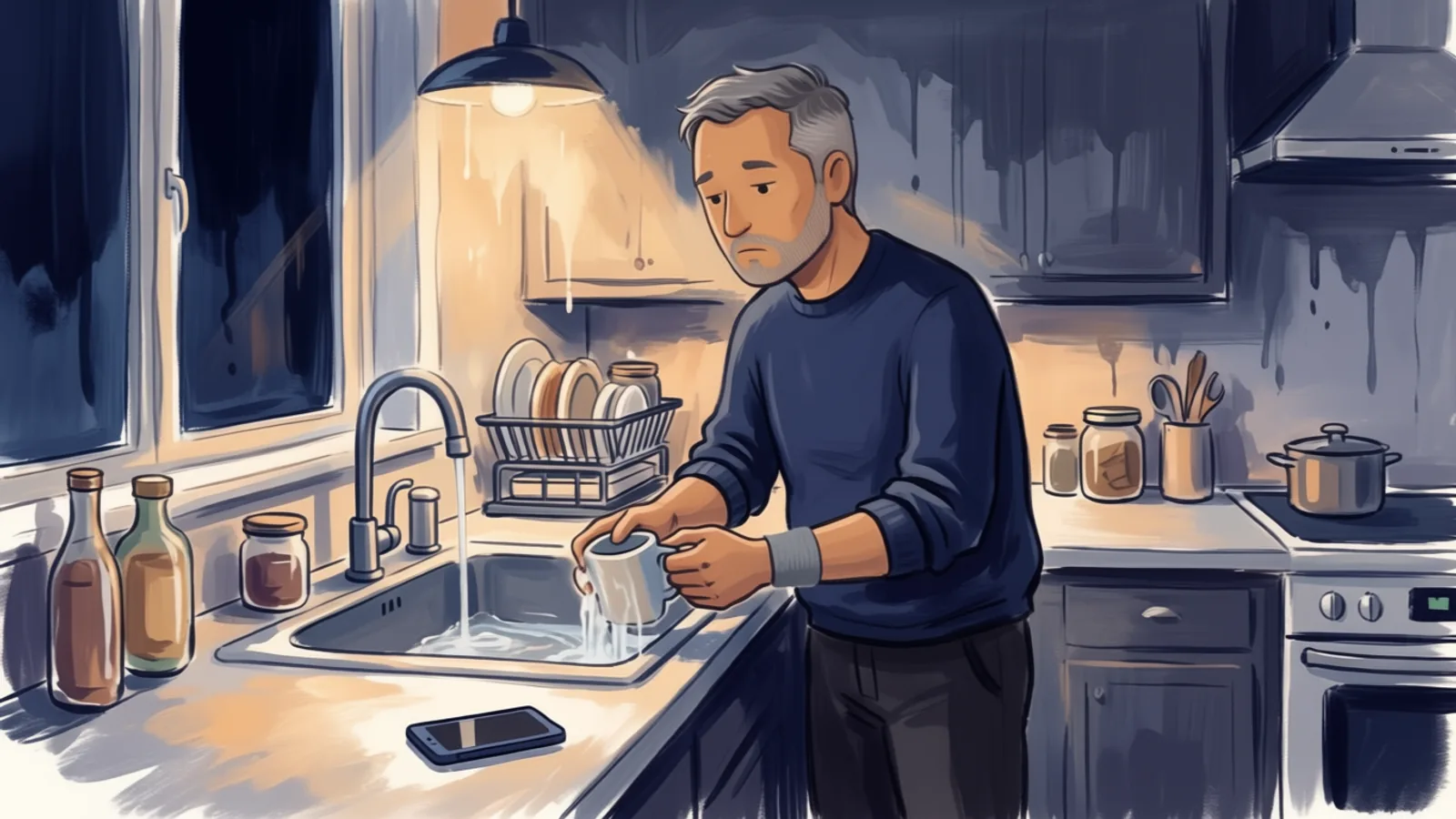
Not every distant partner is avoidant. Common look-alikes:
- Different needs for contact. One person texts all day, the other twice a week. That is a mismatch of preference, not a defence.
- A lack of interest. Sometimes the plain reason for slow replies is that the person is not very into it.
- Life load. Work, health, family and money can make anyone brief and tired.
- Early-stage caution. People who have been hurt go slowly. That fits caution, not necessarily avoidance.
- Controlling behaviour. Going cold as a punishment, using distance to win, or turning a limit into an attack is a different thing from avoidance. The article on how to tell avoidance from something worse covers behaviours that go beyond avoidance, such as control and threats.
The test is the reason for the distance. Avoidance is distance in order to feel safe. Anything meant to hurt or control is something else.
What the research can and can't say
Several things are well supported. Attachment is measured on anxiety and avoidance scales [5]. Avoidant strategies involve turning attachment needs down, and the dismissive and fearful patterns differ in how they do it [1][3].
Other things are weaker. Online lists of "signs" are popular shorthand, not validated checklists. Most of the dating and relationship research on avoidance comes from US samples, often students or couples, using self-report. A large analysis of 43 couples studies found that attachment avoidance and anxiety were among the top individual predictors of relationship quality, but that a person's own view of the relationship, such as perceived commitment and appreciation, predicted far more [6]. In other words, a style says something, and how the relationship actually feels says more.
Also, one partner's avoidance can only ever be inferred from outside. Nobody can put a label on an ex or a date from the behaviour alone, and the same actions can come from other causes. A sign is a reason to look closer, not a conclusion.
Is my partner avoidant? Quizzes and tests
The searches "is my partner avoidant", "is my partner avoidant quiz" and "is my partner an avoidant test" lead to many free tests. Most are short lists of statements. They work as a prompt for thinking, not as a measurement of someone else.
Two tools here suit different situations. The ex quiz asks 24 statements about how a particular person behaved, which suits someone looking back on a relationship that has ended or is ending. The attachment style quiz is about a person's own pattern, which is often the more useful starting point, since a partner's behaviour is easier to read once the reader's own part in the loop is clear. Neither gives a verdict. Both describe a pattern, and the guides listed below turn that pattern into steps.
Sources (6)
- Bartholomew, K. (1990). Avoidance of intimacy: An attachment perspective. Journal of Social and Personal Relationships, 7(2), 147–178. https://doi.org/10.1177/0265407590072001 (abstract; accessed 2026-10-15)
- Bartholomew, K., & Horowitz, L. M. (1991). Attachment styles among young adults: A test of a four-category model. Journal of Personality and Social Psychology, 61(2), 226–244. https://doi.org/10.1037/0022-3514.61.2.226 (abstract; accessed 2026-10-15)
- Mikulincer, M., & Shaver, P. R. (2003). The attachment behavioral system in adulthood: Activation, psychodynamics, and interpersonal processes. Advances in Experimental Social Psychology, 35, 53–152. https://doi.org/10.1016/S0065-2601(03)01002-5 (metadata only; accessed 2026-10-15)
- Simpson, J. A., Rholes, W. S., & Phillips, D. (1996). Conflict in close relationships: An attachment perspective. Journal of Personality and Social Psychology, 71(5), 899–914. https://doi.org/10.1037/0022-3514.71.5.899 (abstract; accessed 2026-10-15)
- Fraley, R. C. A Brief Overview of Adult Attachment Theory and Research. https://labs.psychology.illinois.edu/~rcfraley/attachment.htm (accessed 2026-10-15)
- Joel, S., Eastwick, P. W., et al. (2020). Machine learning uncovers the most robust self-report predictors of relationship quality across 43 longitudinal couples studies. PNAS, 117(32), 19061–19071. https://doi.org/10.1073/pnas.1917036117 (abstract; accessed 2026-10-15)
Keep going
Is your ex an avoidant?
24 statements about how your ex actually behaved. Rate how often each one happened, as you remember it. About four minutes.
Why: hand-picked as a companion
Avoidant deactivation: what it is and what it felt like
What avoidant deactivation means in attachment research, the signs people describe, and why it explains a pattern without diagnosing anyone.
Why: same topic: spotting avoidant patterns
Anxious With a Dismissive-Avoidant Partner: The Survival Guide
The more you reach, the more they pull back. Why the anxious-avoidant loop runs, what each of you needs, and how to step out of the chase.
Why: hand-picked as a companion
More like this
- GuideDismissive-Avoidant Push-Pull, for an Anxious Partner: The Survival Guide
- TermAvoidant attachment
- TermEmotionally unavailable
- ArticleAvoidant or Narcissist? How to Tell the Difference
- ArticleFearful vs Dismissive Avoidant: Key Differences
- ArticleThe Push-Pull Cycle: Why Some Relationships Keep Ending and Restarting
- GuideAnxious With a Fearful-Avoidant Partner: The Survival Guide
- TermDeactivating strategies
- TermDismissive-avoidant attachment