
Article
Fearful vs Dismissive Avoidant: Key Differences
Two people go cold after a good stretch. One does it quietly, with no sign of struggle, and seems relieved. The other does it in the middle of a warm moment, after wanting closeness badly, and seems torn up about it. Both are called avoidant. The difference between them is one of the most searched questions in attachment theory.
This article explains the difference between fearful-avoidant and dismissive-avoidant attachment: how each handles closeness, conflict and endings, where the two names come from, how fearful-avoidant relates to the word "disorganized", and why neither can be read reliably from outside. It describes patterns, not people. Nobody is one box, and the two patterns blur at the edges.
The short answer
Both patterns pull away from closeness. They do it for different reasons.
The dismissive-avoidant pattern plays down the need for closeness. Distance feels safe, self-reliance feels strong, and attachment needs are minimised, often even to the person themselves. The fearful-avoidant pattern wants closeness and fears it at the same time. The need is felt. So is the fear of what closeness might cost.
Bartholomew's research put the split plainly. Dismissing avoidance is "a defensive denial of the need or desire for greater social contact". Fearful avoidance is a conscious desire for contact that is inhibited by fear of its consequences [1]. In short: one pattern turns the need down, the other feels it and is afraid.
That difference shapes almost everything else: how fast the cycle moves, how visible the feeling is, and what the person on the other side sees.
Fearful avoidant vs dismissive avoidant, side by side
| Dismissive-avoidant | Fearful-avoidant | |
|---|---|---|
| Wants closeness? | Plays the wish down, often denies it | Yes, and fears it |
| View of self | Positive; self-sufficient | Negative; worried about being unlovable |
| View of others | Distrusts or undervalues dependence on them | Wary; expects to be hurt |
| Pace of the cycle | Slow: weeks or months | Fast: days, sometimes hours |
| Feelings | Low on the surface | Strong, then withdrawn |
| In conflict | Calm, flat, absent or leaves | Intense, then shuts down |
| After a breakup | Described as calm, self-reliant, little visible distress | Often mixed: reaching out and pulling back |
| Popular label | "Avoidant" | "Disorganized", "oscillating" |
The model behind the table is the four-category model by Bartholomew and Horowitz. It builds four styles from two things: whether a person holds a positive or negative view of themselves, and a positive or negative view of others. Dismissing combines a positive self-view with a negative view of others, and fearful combines negative views of both [2]. A modern two-dimension view places both on a high-avoidance scale and separates them by anxiety: low for dismissive, high for fearful [7].
What the dismissive-avoidant pattern looks like
The dismissive pattern runs on deactivating strategies: turning attention and feeling away from attachment needs when closeness rises [5]. The glossary entry on dismissive-avoidant and the full profile describe it in more detail.
Commonly described features:
- Self-reliance as identity. "I don't need anyone" is not a pose. It is a stable way of managing feeling.
- Low visible distress. Disagreements stay calm. Endings look easy.
- Space after closeness. A warm weekend is followed by quiet. The deactivation article, avoidant deactivation, covers the sequence.
- Slow cycles. Cooling over weeks, going quiet for months, then returning as if nothing happened.
- Minimising. "It wasn't a big deal." Not necessarily a lie. Attachment needs are turned down even in the person's own awareness [1].
This is not a lack of feeling. Bartholomew describes the pattern as a defensive denial, and the research refers to minimising awareness of distress, not to its absence [1].
What the fearful-avoidant pattern looks like

The fearful pattern combines wanting closeness with expecting pain from it. The fearful-avoidant glossary entry and profile cover it in full. In Levine's popular framing the fearful pattern is "oscillation": swinging between pulling people close and pushing them away [6].
Commonly described features:
- Fast warmth, fast retreat. Closeness is reached for, then pulled back from, within a short time.
- Visible feeling. Strong emotions are often shown, and sometimes retracted afterwards.
- A negative self-view. Fear that the other person will see something unlovable and leave, so leaving first feels safer.
- Mixed messages. Warm words with cold behaviour, or the reverse. The glossary calls this hot and cold.
- Intensity in conflict. An argument can escalate quickly and then end in withdrawal.
For the person on the other side, the fearful pattern is often the more confusing, because the warmth is real and so is the retreat. The push-pull cycle article describes how the loop runs.
Where the two names come from
The words come from different traditions, which is part of the confusion.
"Dismissing" and "fearful" are from Bartholomew's 1990 paper and the 1991 four-category model with Horowitz [1][2]. Both are measured on self-report questionnaires and interviews in adults. The popular dating world turned "dismissing" into "dismissive" and added the "avoidant" tag to both.
The other name for fearful avoidant, "disorganized", has a different origin, covered next. Popular writing also uses "anxious-avoidant" for the fearful pattern, and that is easily confused with the pairing of an anxious partner with an avoidant one. That pairing is covered in the anxious-avoidant trap.
Fearful-avoidant and "disorganized"
Online, fearful-avoidant is often called "disorganized attachment". The word "disorganized" comes from infant research: Main and Solomon added a "disorganized/disoriented" category to Ainsworth's three infant patterns, for infants who showed contradictory behaviour toward a caregiver [3]. The glossary entry on disorganized attachment gives the short version.
Treat the equation of the two as popular shorthand. A 2017 review by 43 attachment researchers, including some of the people who defined the infant category, warns against several common assumptions, and says there is little evidence that the infant category and self-report romantic styles refer to the same thing [3]. Some adult researchers have linked fearful avoidance and disorganization as a direction for future research, not as a settled equivalence [4].
What this means for the article: "fearful-avoidant" is the adult, questionnaire-based name used here. "Disorganized" is an infant-research term used loosely online. The two overlap in description, and nobody can honestly call a particular person "disorganized" from the outside. The behaviours are a good fit for what the fearful pattern describes. The label's origin is uncertain.
Telling them apart in practice
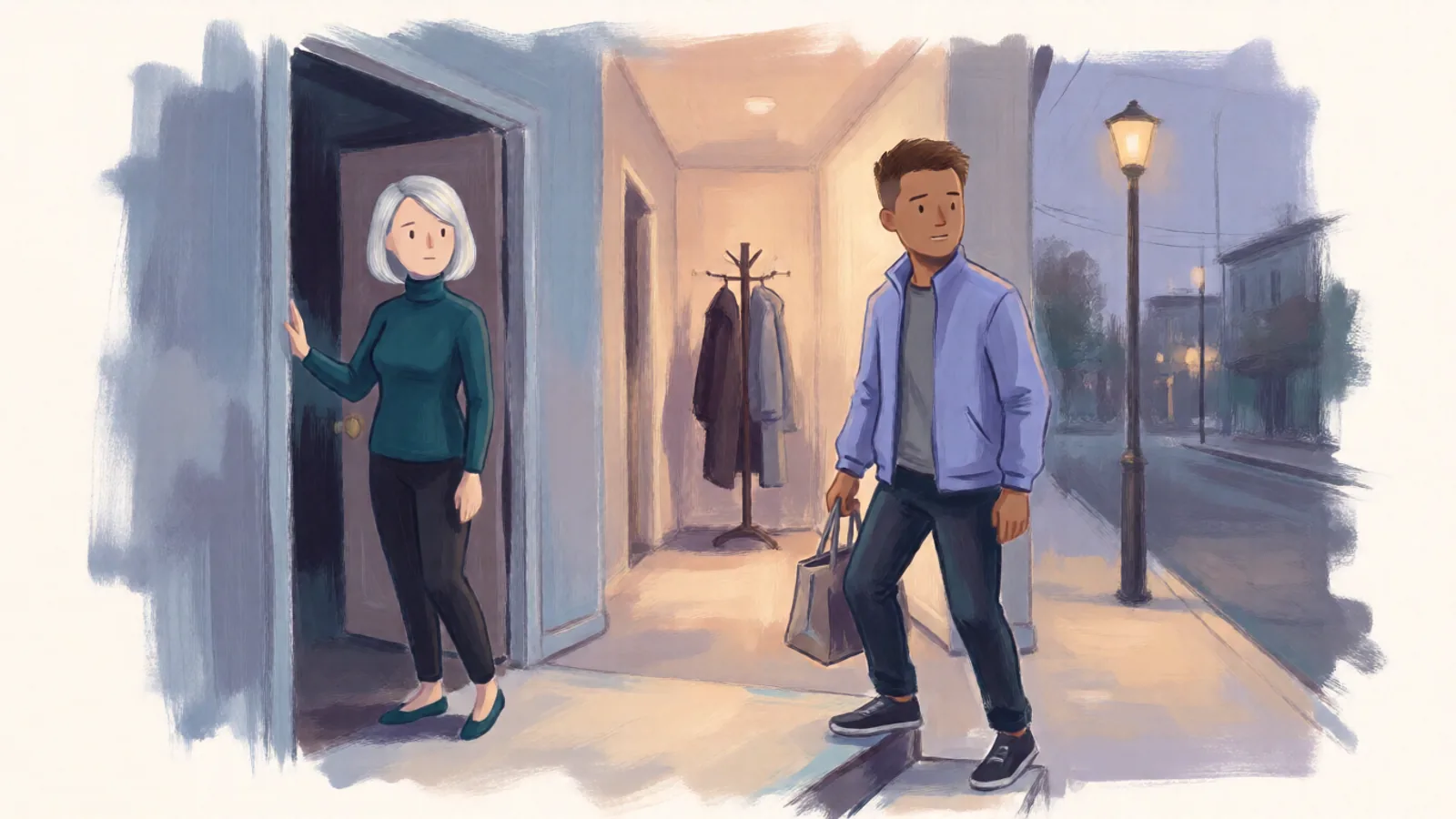
From outside, the two can look alike: a person is warm, then distant. A few questions help, though none is conclusive.
- Is the feeling visible? A fearful pattern tends to show the want and the fear. A dismissive pattern tends to show neither.
- How fast is the cycle? Days point to the fearful pattern, weeks or months to the dismissive one.
- What happens after the retreat? A fearful pattern can come with regret, distress or an urge to repair. A dismissive pattern tends to settle into calm.
- What do they say about themselves? "I'm too much" or "I always ruin things" fits a fearful self-view. "I'm just independent" fits a dismissive one.
The honest limit: the styles are measured with questionnaires and interviews on groups, over time. Neither can be pinned down from one memory of a relationship. Attachment is better described by two sliding scales than by boxes [7], and a person can show different patterns with different partners.
The attachment style quiz places a person on both scales. The ex quiz looks at how a specific past partner behaved. For the "what do I do" version, see the anxious with a dismissive-avoidant guide and the anxious with a fearful-avoidant guide.
Sources (7)
- Bartholomew, K. (1990). Avoidance of intimacy: An attachment perspective. Journal of Social and Personal Relationships, 7(2), 147–178. https://doi.org/10.1177/0265407590072001 (abstract; accessed 2026-10-15)
- Bartholomew, K., & Horowitz, L. M. (1991). Attachment styles among young adults: A test of a four-category model. Journal of Personality and Social Psychology, 61(2), 226–244. https://doi.org/10.1037/0022-3514.61.2.226 (abstract; accessed 2026-10-15)
- Granqvist, P., Sroufe, L. A., Dozier, M., Hesse, E., Steele, M., van IJzendoorn, M., Solomon, J., ... Duschinsky, R. (2017). Disorganized attachment in infancy: A review of the phenomenon and its implications for clinicians and policy-makers. Attachment & Human Development, 19(6), 534–558. https://doi.org/10.1080/14616734.2017.1354040 (abstract and open-access full text; accessed 2026-10-15)
- Simpson, J. A., & Rholes, W. S. (2002). Fearful-avoidance, disorganization, and multiple working models: Some directions for future theory and research. Attachment & Human Development, 4(2), 223–229. https://doi.org/10.1080/14616730210154207 (metadata only; accessed 2026-10-15)
- Mikulincer, M., & Shaver, P. R. (2003). The attachment behavioral system in adulthood: Activation, psychodynamics, and interpersonal processes. Advances in Experimental Social Psychology, 35, 53–152. https://doi.org/10.1016/S0065-2601(03)01002-5 (metadata only; accessed 2026-10-15)
- Levine, A. Author website, amirlevinemd.com. https://www.amirlevinemd.com/ (accessed 2026-10-15)
- Fraley, R. C. A Brief Overview of Adult Attachment Theory and Research. https://labs.psychology.illinois.edu/~rcfraley/attachment.htm (accessed 2026-10-15)
Keep going
Is your ex an avoidant?
24 statements about how your ex actually behaved. Rate how often each one happened, as you remember it. About four minutes.
Why: hand-picked as a companion
What's your attachment style?
36 statements about how you tend to feel and act in close romantic relationships. Takes about 8 minutes. You get two scores, anxiety and…
Why: hand-picked as a companion
Avoidant or Narcissist? How to Tell the Difference
Avoidance and narcissistic behaviour can look alike after a breakup. How the patterns differ, what the research finds, and when it is…
Why: same topic: spotting avoidant patterns
More like this
- ArticleAvoidant Red Flags: Signs of an Avoidant Partner
- TermAvoidant attachment
- ArticleThe Anxious-Avoidant Trap: Why It Happens
- ArticleAvoidant deactivation: what it is and what it felt like
- GuideAnxious With a Dismissive-Avoidant Partner: The Survival Guide
- GuideAnxious With a Fearful-Avoidant Partner: The Survival Guide
- GuideDismissive-Avoidant Push-Pull, for an Anxious Partner: The Survival Guide
- GuideFearful-Avoidant Push-Pull, for an Anxious Partner: The Survival Guide
- TermDismissive-avoidant attachment