
Article
Avoidant or Narcissist? How to Tell the Difference
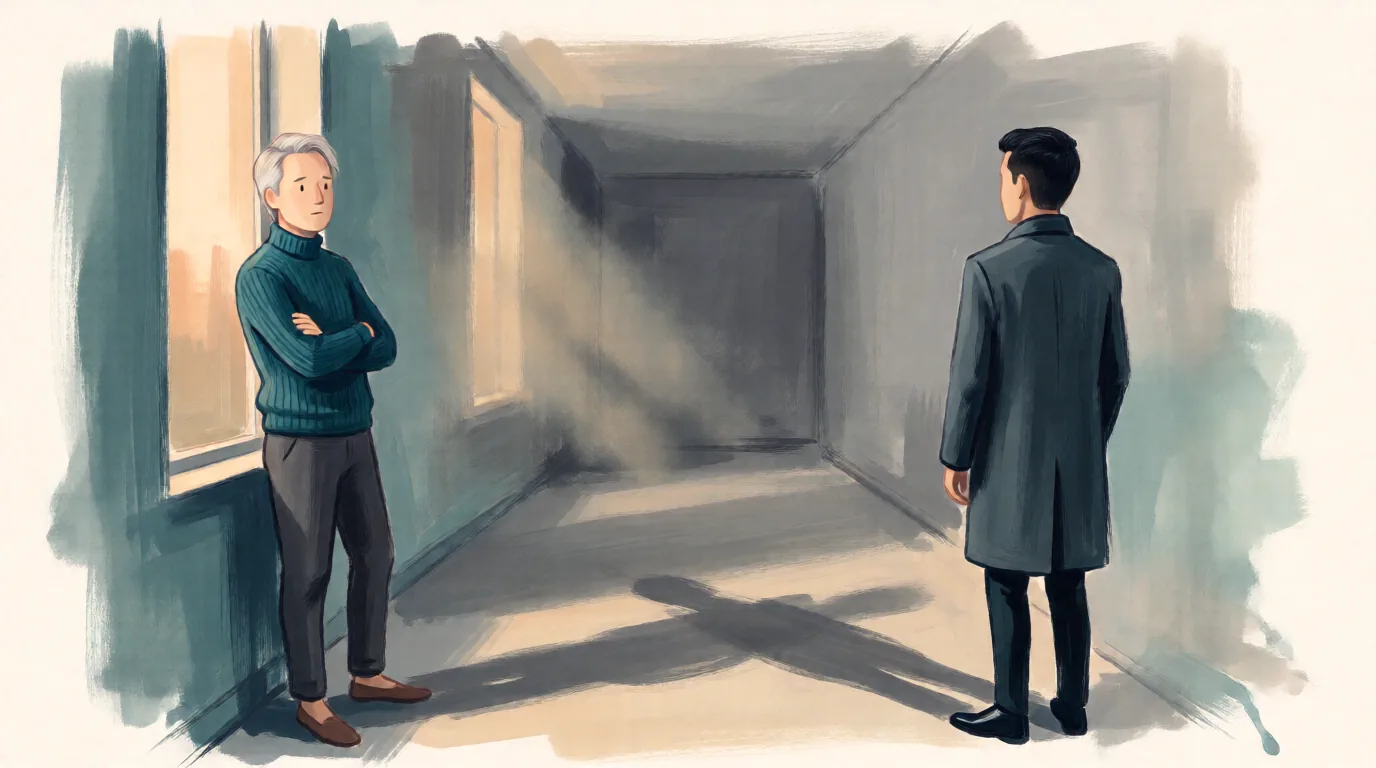
After a painful ending, two words keep turning up in the search bar: avoidant and narcissist. Both describe someone who went cold, stopped answering, and left the other person confused. The behaviour can look the same from the outside. What sits underneath it is different, and so is what it asks of the person on the receiving end.
This article compares the two patterns side by side. It covers dismissive-avoidant, fearful-avoidant and covert (vulnerable) narcissistic behaviour, what a large 2025 review of the research found, and why nobody can settle the question about a particular ex from the outside. It describes behaviours and patterns, not people. The point is a working rule: avoidance is protection, abuse is control, and the two can happen together.
The short answer
Avoidance is mostly about getting away from closeness. Abuse is mostly about keeping control. That is the shortest honest way to tell them apart.
A person acting from avoidance pulls back when things get close or demanding. They go quiet, go busy, change the subject or leave. The distance protects them from a feeling they find too big. It does not need the other person to suffer, and it usually does not escalate when the other person says "no" or sets a limit. It just gets quieter.
A person acting from control uses closeness and distance as tools. Warmth is switched on to win someone back and switched off to punish them. A limit is treated as an attack and answered with blame, threats or humiliation. The other person ends up managing the relationship so as to avoid the next punishment.
Real relationships are messier than this. Avoidant behaviour can turn cruel, and controlling behaviour can look like withdrawal. Behaviour over time, and what happens when a limit is set, tells more than any single moment. The word "narcissist" is also used far more loosely online than in research, which is part of why this question is so confusing.
The patterns side by side

This table describes patterns people report, not a test. Any single row can fit either pattern, and the pattern over time carries the most weight.
| Avoidant pattern | Controlling or narcissistic pattern | |
|---|---|---|
| Why they pull away | Closeness or demands feel like too much; distance brings relief [2] | The relationship stops serving them, or the other person stops giving what they want |
| When a limit is set | Goes quiet, withdraws more, may accept it with little reaction | Anger, blame, guilt, threats, or a reversal where the limit-setter becomes the problem [5] |
| Remorse and repair | Often awkward or absent, but a sincere apology is possible and may be followed by real change | Apology is used to restore access; the old pattern returns once the other person is back |
| Contact after the ending | Drifts back when the pressure has gone, then pulls back again when closeness is asked for | Reappears to pull the person back in, often with flattery, a crisis or promises [6] |
| The pattern over time | Warm, then distant, then warm; the distance protects them | Idealise, devalue, discard, then return; the cycle gives them control |
| What the other person feels | Confused, lonely, "never enough" | Afraid, small, doubting their own memory |
If the right-hand column sounds like a relationship that has just ended, the glossary entries on hoovering, love bombing, idealize, devalue, discard and trauma bond explain where each word comes from. They are survivor-community words, not diagnoses.
Dismissive-avoidant or narcissistic?

The dismissive-avoidant pattern in attachment research is a defensive turning-down of the need for closeness. Bartholomew described it as a positive view of the self that keeps awareness of distress low [2]. In the two-scale picture, it is low on anxiety and high on avoidance [3][4]. See the dismissive-avoidant profile for the full pattern.
From the outside, this can look like coldness: slow replies, "I need space", a sudden ending that seems calm. That is why it gets mistaken for narcissistic behaviour. The difference tends to show up in what happens next. A dismissive pattern usually means less contact, less reaction and less interest in the other person's feelings. It does not usually mean sustained effort to make that person feel small.
Two questions help. After the ending, did the contact stop, or did it turn into pressure? And when the other person said what they needed, was the answer distance, or was it blame? Distance points toward avoidance. Blame and pressure point toward control. The article on the avoidant discard covers how the abrupt ending feels and what it does and doesn't say about the person left behind.
Fearful-avoidant or narcissistic?
The fearful-avoidant pattern sits high on both scales: a real wish for closeness, held back by fear of what closeness brings [2][3]. See the fearful-avoidant profile. It is hot and cold, and the heat is real on both sides.
That is exactly why it gets confused with narcissistic behaviour. Intense closeness followed by sudden distance, then a return, looks like a cycle of idealising and discarding. The difference is who the cycle is for. In a fearful-avoidant push-pull, the person pulling away is often as distressed as the person being left. The fear drives the pulling away, and the loneliness drives the return. Both halves are felt.
In a controlling pattern, the cold phase is aimed at the other person: criticism, silence as punishment, humiliation. The warm phase is aimed at getting something. The article on the push-pull cycle describes the fearful-avoidant cycle in detail. The fearful-avoidant push-pull guides cover what to do about it.
Covert narcissism and avoidance

Researchers separate two kinds of narcissism. The grandiose kind is the loud, confident, entitled one. The vulnerable (or covert) kind is more sensitive, easily hurt, defensive and often withdrawn. People searching "covert narcissist vs avoidant" are usually trying to work out which of those quiet, hurt, distant behaviours they ran into.
The overlap is real, and it is a reason the comparison is hard. Both can sulk, withdraw and seem unreachable. Both can be hurt by criticism. The difference people describe is in the aim. A withdrawn avoidant pattern is trying to feel safe. A covert narcissistic pattern is trying to feel important or to be rescued from feeling small, and it can punish the other person for that failing: sarcasm, blame, a cold shoulder that is meant to be felt.
Neither description can be confirmed from outside. The same person can show both, and many people with an avoidant pattern are quietly sensitive too. What stays useful is the question of what the behaviour does to the other person, and whether it eases or intensifies when a limit is set.
What the research says
The best direct evidence is a 2025 systematic review and meta-analysis of 33 studies with 10,675 participants, published in Personality and Individual Differences [1]. It asked how adult attachment styles relate to trait narcissism. The reviewers found that only vulnerable narcissism was associated with insecure attachment. Grandiose narcissism was not.
Within vulnerable narcissism, the link was strongest for preoccupied (anxious) attachment, with a correlation of about 0.43 across 17 studies. It was moderate for fearful attachment (about 0.31, 6 studies), and weak for dismissive attachment (about 0.15, 17 studies) [1].
What this means, and what it doesn't:
- Dismissive avoidance is not the same thing as narcissism. The link is weak. Most of the overlap sits with anxious and fearful styles.
- These are correlations between traits across groups. They do not say that any one person with an attachment style has narcissistic traits, or the reverse.
- Trait narcissism is not abuse. The studies measured traits with questionnaires. They did not measure whether anyone was controlled, isolated or hurt.
- This is one review. The abstract is what was read here, not the full paper, and the field is young.
The research does not say that a cold ex must be one or the other. It says the two overlap at the vulnerable end, and mostly through anxious and fearful attachment.
Are avoidants narcissists?
No. That is what the research shows, and it matches how attachment theory describes avoidance. Attachment researchers treat avoidance as a matter of degree rather than a category [4], and the largest review found only a weak link between dismissive attachment and vulnerable narcissism [1].
The belief comes from the way breakups feel. Someone who goes cold, who seems unaffected, who ends things without an explanation, feels like they must be hurting on purpose. Online communities then reach for narcissism as the word that fits the feeling. A cold exit can be painful, careless and unkind without being a pattern of control. Equally, a person with an avoidant style can also behave abusively. Style does not tell you that.
There is also a harder truth. Many avoidant exits are the other person protecting themselves, not aiming at anyone. That does not make the exit fine. It means the hurt was real and the intent may not have been cruel, and both of those can be true.
Why you can't diagnose an ex, and why you don't need to

Nobody can diagnose a person they dated, however well they remember the relationship. Narcissism and attachment style are both things researchers measure with questionnaires and interviews, usually on groups, over time. A memory of a breakup is one side of a story told while hurting.
The words themselves also drift. "Discard", "hoovering", "love bombing" and "supply" come from survivor communities, not from clinics. They name patterns that people recognised in their own lives. A Psych Central piece on the topic describes hoovering as a person coming back to pull a former partner into the old pattern [6]. They are useful descriptions and poor diagnoses.
The good news is that a label is not needed to decide what to do. The practical questions are about behaviour:
- Does contact respect a "no", or does it escalate?
- Does the person take any responsibility, or turn the problem around? Freyd's DARVO description (deny, attack, reverse victim and offender) names that reversal [5].
- Is the relationship safe to stay in, or to return to?
Those can be answered from what happened. The ex quiz, "Is an ex avoidant?" looks at the avoidant side of that picture. It describes a pattern; it does not rule abuse in or out.
When it's abuse, not avoidance
Some behaviours are not avoidance, whatever attachment style is in the background. Describing them plainly:
- Control. Deciding who the other person sees, what they wear, where they go, how they spend money.
- Threats. Threats of harm, of leaving, of exposing something or of taking something away, used to get a result.
- Isolation. Cutting the other person off from friends and family, or making contact with them costly.
- Constant belittling. Ongoing criticism, mockery or humiliation, in private or in front of others.
- Punishing limits. Rage, silence or retaliation whenever the other person says no, sets a boundary or asks for something.
Avoidance does not require any of these. Distance does not require threats. When these behaviours are present, the usual avoidant advice (give space, don't pressure, let them come to you) does not fit. The response needs to be about safety and distance, not patience. The two can also exist together: an avoidant style does not prevent controlling behaviour, and it does not excuse it.
If any of this describes a relationship now, the US National Domestic Violence Hotline can be reached at 1-800-799-7233, or by texting START to 88788 [7]. Outside the US, search for your local domestic violence service.
Sources (7)
- Mohay, J., Cheng, K., de la Piedad Garcia, X., & Willis, M. L. (2025). The relationship between attachment styles and narcissism: a systematic and meta-analytic review. Personality and Individual Differences. https://doi.org/10.1016/j.paid.2025.113255 (abstract read via OpenAlex; full paper not opened; accessed 2026-10-15)
- Bartholomew, K. (1990). Avoidance of intimacy: An attachment perspective. Journal of Social and Personal Relationships, 7(2), 147–178. https://doi.org/10.1177/0265407590072001 (abstract; accessed 2026-10-15)
- Bartholomew, K., & Horowitz, L. M. (1991). Attachment styles among young adults: A test of a four-category model. Journal of Personality and Social Psychology, 61(2), 226–244. https://doi.org/10.1037/0022-3514.61.2.226 (abstract; accessed 2026-10-15)
- Fraley, R. C. A Brief Overview of Adult Attachment Theory and Research. https://labs.psychology.illinois.edu/~rcfraley/attachment.htm (accessed 2026-10-15)
- Freyd, J. J. DARVO. Author website. https://www.jjfreyd.com/darvo (accessed 2026-10-15)
- Arabi, S. (2019). 5 Ways Malignant Narcissists "Hoover" Their Victims. Psych Central. https://psychcentral.com/blog/recovering-narcissist/2019/12/5-ways-malignant-narcissists-hoover-their-victims (accessed 2026-10-15)
- The National Domestic Violence Hotline (US). https://www.thehotline.org/ (phone number and text code confirmed on the home page; accessed 2026-10-15)
Keep going
Is your ex an avoidant?
24 statements about how your ex actually behaved. Rate how often each one happened, as you remember it. About four minutes.
Why: hand-picked as a companion
Avoidant Red Flags: Signs of an Avoidant Partner
The signs of an avoidant partner in early dating and later on, how to tell avoidance from anxiety and from plain mismatch, and what the…
Why: same topic: spotting avoidant patterns
Fearful vs Dismissive Avoidant: Key Differences
Fearful-avoidant and dismissive-avoidant are the two avoidant patterns. How they differ in closeness, conflict and breakups, and what the…
Why: same topic: spotting avoidant patterns
More like this
- TermIdealize, devalue, discard
- ArticleAvoidant deactivation: what it is and what it felt like
- ArticleThe avoidant discard: what happened, and what it doesn't mean about you
- GuideDismissive-Avoidant Push-Pull, for an Anxious Partner: The Survival Guide
- GuideFearful-Avoidant Push-Pull, for an Anxious Partner: The Survival Guide
- TermAvoidant discard
- ArticleDo Avoidants Come Back? Avoidant Hoovering Explained
- TermAvoidant attachment
- TermDARVO