
Article
Why Do Avoidants Ghost? Attachment, Silence and What Comes Next
The messages were warm on Tuesday. There were plans for the weekend. Then nothing: texts delivered and never answered, a profile still active, no explanation at all. The silence is its own message, and it is a hard one to read.
Ghosting is one of the most searched questions about avoidant partners, and for good reason. Many people who have been ghosted later learn about attachment theory and see their story in it. This article covers what the research actually says about attachment and ghosting, why the avoidant pattern leans toward silence, how dismissive and fearful ghosting tend to differ, and what to do once it has happened. It describes patterns and behaviour, not verdicts on any one person.
What ghosting is
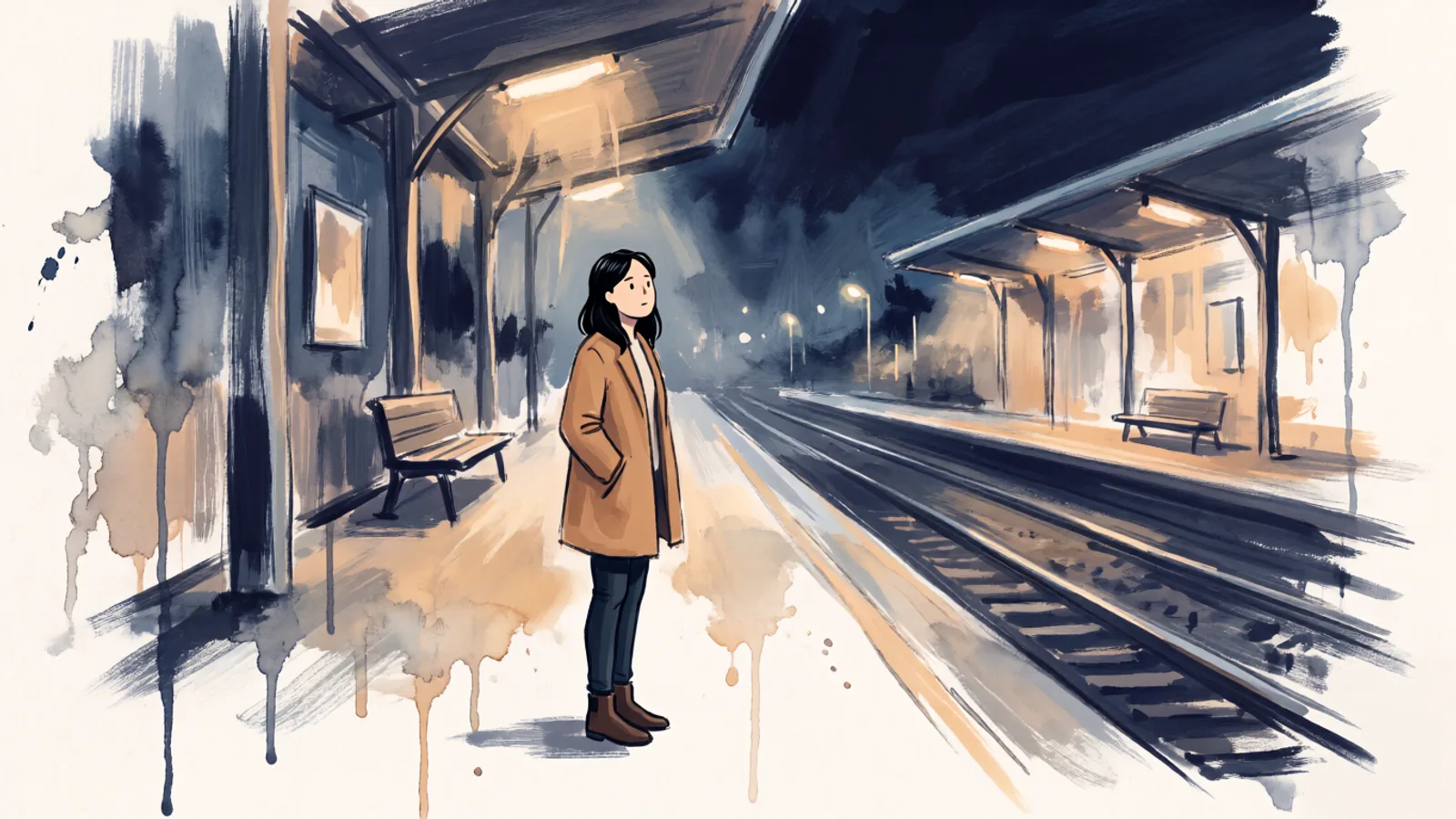
Ghosting is ending a connection by cutting off all communication without explanation, and then ignoring attempts to restart it. The glossary entry on ghosting has the short definition. One of the first research papers on it called it a "digital dissolution disappearance strategy" [1]: a way of ending things that happens through phones and apps, by simply not being there any more.
A few things are not ghosting:
- A slow reply. Busy weeks and long gaps are not the same as a cut-off.
- No contact after a clear ending. Going quiet to recover after a relationship has ended is a boundary, not a disappearance. The guide to no contact with an avoidant ex explains the difference, and its section on what happens when you ghost an avoidant covers the reverse situation.
- The silent treatment. The silent treatment happens inside an ongoing relationship, usually during conflict. Ghosting ends the relationship.
Close cousins exist too. Breadcrumbing keeps someone on a thin line of occasional attention. Ghosting cuts the line.
Ghosting is not only an avoidant habit
Before getting to attachment, one honest point: ghosting is common, and plenty of people who ghost would not fit the avoidant pattern at all. In one qualitative study of 99 emerging adults, most participants reported having been on both sides, as the person who ghosted and the person who was ghosted [1]. It is a widespread way of ending things, not a rare signature of one style.
Other factors predict ghosting as well as, or better than, attachment. People who hold "destiny" beliefs about relationships (the idea that a relationship is either meant to be or it isn't) rated ghosting as more acceptable and were more likely to have used it [2]. A 2023 encyclopedia entry reviewing the ghosting literature reports that people high in manipulative, callous personality traits (the so-called dark triad) are more likely than others to ghost [3]. Context matters too. A few dates on an app, a fading friendship and a two-year relationship are very different situations, and the same act means different things in each.
So ghosting on its own says little about anyone's attachment style. It is one behaviour among many, and a single disappearance is not a verdict on anyone.
What the attachment research found
The most direct study is a set of three studies of attachment and ghosting, with 165, 247 and 863 participants [4]. Attachment was measured on the two standard dimensions, anxiety and avoidance. Two findings stand out:
- People who had ghosted a partner scored higher on attachment avoidance than people with no ghosting experience. That held in the largest, pre-registered sample.
- People who had been ghosted scored higher on attachment anxiety than people who hadn't.
The authors' own summary is careful, though. The findings they describe as consistent across all three studies are the link between attachment anxiety and being ghosted, and the link between destiny beliefs and ghosting someone [4]. The avoidance link is real but smaller and less central than popular content suggests. These are correlations in self-report samples, not proof that avoidance causes ghosting.
An older study points the same way without using the word "ghosting". People higher in attachment avoidance were more likely to end relationships through indirect strategies such as avoidance and withdrawal, while people higher in anxiety leaned toward strategies that kept the door open to getting back together [5]. In later experiments in the same paper, reminders of security made people choose more direct ways of breaking up [5]. That last result matters: indirect exits look like a strategy that shifts with how safe someone feels, not a fixed trait.
Why the avoidant pattern leans toward silence
Attachment researchers describe avoidance as running on deactivating strategies: turning attention away from attachment needs and emotions when closeness rises [6]. The article on avoidant deactivation covers how this looks day to day. A breakup conversation is close to the worst case for a deactivating strategy. It means sitting with someone else's hurt, explaining feelings, and staying present through conflict. Silence skips all of that.
The research on how ghosting feels from the ghoster's side fits this. In a large sample of people who had recently broken up, those who ended things by ghosting reported less distress than those who ended things directly, and ghosting breakups involved more avoidance and withdrawal tactics [7]. In another study of 80 people who had been on both sides, participants described ghosting others with guilt and relief, and being ghosted with sadness and hurt [8]. Relief is the part that matters here. For someone whose system turns feelings down, silence works in the short term.
Two other points keep this fair. People who ghost often say they want to avoid hurting the other person, and those who are ghosted tend to underestimate that motive [10]. And avoidance is self-protection, not abuse. Ghosting is a poor way to end things, and it hurts. It is not the same as a campaign to harm someone. The article on the avoidant discard covers abrupt endings in more depth.
Dismissive-avoidant vs fearful-avoidant ghosting

No study has compared ghosting across the two avoidant patterns directly. The research measured avoidance as one scale [4], not as separate types. What follows is an inference from how the two patterns are defined [9], so treat it as a guide to recognise, not a test.
Dismissive avoidance has been described as "a defensive denial of the need or desire for greater social contact" [9]. Fearful avoidance is a wish for closeness held back by fear of what closeness will cost [9]. The fearful vs dismissive avoidant article covers the full difference.
| Dismissive-avoidant pattern | Fearful-avoidant pattern | |
|---|---|---|
| When it tends to happen | When the relationship asks for more commitment or feeling | When closeness feels good and then frightening, or after conflict |
| What it can look like | A calm, clean fade; no visible drama | Sudden disappearance after an intense high, sometimes mid-conversation |
| What seems to drive it | Closing a door that felt like a demand | Getting out before being hurt or rejected |
| After the silence | Often stays gone, or returns casually much later | More likely to reappear, apologise, then pull away again |
| How it can feel to the other person | Cold, as if it meant nothing | Confusing, hot and cold, hard to let go of |
Both patterns can produce the same silence. The difference is mostly in what surrounds it. For more on each, see the glossary entries on the dismissive-avoidant and fearful-avoidant patterns.
Do avoidants ghost and come back?
Some do, and many don't. No study follows people who ghost to see who returns, so anyone offering a timeline is guessing. The article on whether avoidants come back covers this in full. The short version: the same deactivation that makes silence feel like relief can, once the pressure is gone, make closeness feel safe again. A message weeks or months later is a recognisable story, not a measured finding.
When a return happens, it rarely comes with the explanation the ghosted person wanted. It is more often a casual "hey", a like, or a reply to an old story as if nothing happened. In one study of 208 young adults recalling being ghosted or rejected, researchers described a sequence of reactions: surprise and confusion, then anger, sadness and guilt, then attempts to repair the relationship, and finally acceptance [11]. A return can pull someone straight back to the confusion at the start.
A return is not the same as change. What matters is what happens the next time closeness is on the table.
What to do after being ghosted

There is no formula, but the research on being ghosted points to a few useful moves.
- Name what happened. The researchers in [11] treated ghosting as a form of ostracism: being excluded without explanation. People who were ghosted reported more threat to their basic needs, such as self-esteem and a sense of control, than the people who ghosted them [8]. The pain is not an overreaction.
- Stop searching for the reason. The explanation may never arrive, and the most likely ones (relief, conflict avoidance, a wish not to hurt) say more about the other person's strategy than about anyone's worth [7] [10].
- Cut the inputs. Checking profiles and rereading messages keeps the question open. The guide to no contact covers the practical steps.
- Look at the pattern, if there was one. A single silence is information. A history of pulling away, small comebacks and longer silences is a pattern. The is my ex avoidant? quiz helps sort what happened into behaviour, not labels.
Being ghosted still hurts, whatever the reason behind it. Understanding the pattern does not mean excusing it. It is fine to be done.
Reaching out after an avoidant goes silent
Whether to send one more message is a personal call, not a research question. A few things help with it.
One clear closing message can be worth sending if it is for the sender's own peace, not a bid for a reply. Something like "I'm taking the silence as a no. Take care." says what needs to be said and asks for nothing. Sending it with no expectation of an answer is the point.
Repeated messages tend to work against the sender. For someone running on deactivation, pressure usually means more distance [6]. And for the person sending them, each unanswered text restarts the waiting.
If a reply does come, it is fair to ask for what was missing: an actual conversation, and some sign of a different way of handling hard moments. If what comes back is another vague message, that is an answer too. The silence was an answer the first time.
Sources
- LeFebvre, L. E., Allen, M., Rasner, R. D., Garstad, S., Wilms, A., & Parrish, C. (2019). Ghosting in emerging adults' romantic relationships: The digital dissolution disappearance strategy. Imagination, Cognition and Personality, 39(2), 125–150. https://doi.org/10.1177/0276236618820519 (abstract; accessed 2026-10-15)
- Freedman, G., Powell, D. N., Le, B., & Williams, K. D. (2019). Ghosting and destiny: Implicit theories of relationships predict beliefs about ghosting. Journal of Social and Personal Relationships, 36(3), 905–924. https://doi.org/10.1177/0265407517748791 (abstract; accessed 2026-10-15)
- Daraj, L. R., Buhejji, M. R., Perlmutter, G., Jahrami, H., & Seeman, M. V. (2023). Ghosting: Abandonment in the digital era. Encyclopedia, 4(1), 36–45. https://doi.org/10.3390/encyclopedia4010004 (abstract; accessed 2026-10-15)
- Powell, D. N., Freedman, G., Williams, K. D., Le, B., & Green, H. (2021). A multi-study examination of attachment and implicit theories of relationships in ghosting experiences. Journal of Social and Personal Relationships, 38(7), 2225–2248. https://doi.org/10.1177/02654075211009308 (abstract; accessed 2026-10-15)
- Collins, T. J., & Gillath, O. (2012). Attachment, breakup strategies, and associated outcomes: The effects of security enhancement on the selection of breakup strategies. Journal of Research in Personality, 46(2), 210–222. https://doi.org/10.1016/j.jrp.2012.01.008 (metadata and published summaries; abstract not accessible; accessed 2026-10-15)
- Mikulincer, M., & Shaver, P. R. (2003). The attachment behavioral system in adulthood: Activation, psychodynamics, and interpersonal processes. Advances in Experimental Social Psychology, 35, 53–152. https://doi.org/10.1016/S0065-2601(03)01002-5 (metadata only; accessed 2026-10-15)
- Koessler, R. B., Kohut, T., & Campbell, L. (2019). When your boo becomes a ghost: The association between breakup strategy and breakup role in experiences of relationship dissolution. Collabra: Psychology, 5(1), 29. https://doi.org/10.1525/collabra.230 (abstract; accessed 2026-10-15)
- Freedman, G., Powell, D. N., Le, B., & Williams, K. D. (2024). Emotional experiences of ghosting. The Journal of Social Psychology, 164(3), 367–386. https://doi.org/10.1080/00224545.2022.2081528 (abstract; accessed 2026-10-15)
- Bartholomew, K. (1990). Avoidance of intimacy: An attachment perspective. Journal of Social and Personal Relationships, 7(2), 147–178. https://doi.org/10.1177/0265407590072001 (abstract; accessed 2026-10-15)
- Park, Y., & Klein, N. (2024). Ghosting: Social rejection without explanation, but not without care. Journal of Experimental Psychology: General, 153(7), 1765–1789. https://doi.org/10.1037/xge0001590 (abstract; accessed 2026-10-15)
- Pancani, L., Mazzoni, D., Aureli, N., & Riva, P. (2021). Ghosting and orbiting: An analysis of victims' experiences. Journal of Social and Personal Relationships, 38(7), 1987–2007. https://doi.org/10.1177/02654075211000417 (abstract; accessed 2026-10-15)
Keep going
Do Avoidants Come Back? Avoidant Hoovering Explained
Some avoidant exits are followed by a message months later. Why the pull returns, what it looks like, and how it differs from hoovering in…
Why: same topic: deactivation and distance
Is your ex an avoidant?
24 statements about how your ex actually behaved. Rate how often each one happened, as you remember it. About four minutes.
Why: hand-picked as a companion
The avoidant discard: what happened, and what it doesn't mean about you
Where the term avoidant discard comes from, how it differs from an ordinary breakup, and why it says more about a pattern than about your…
Why: same topic: the discard and ghosting
More like this
- GuideAnxious With a Dismissive-Avoidant Partner: The Survival Guide
- GuideDismissive-Avoidant Push-Pull, for an Anxious Partner: The Survival Guide
- ArticleAvoidant or Narcissist? How to Tell the Difference
- ArticleAvoidant Red Flags: Signs of an Avoidant Partner
- ArticleThe Push-Pull Cycle: Why Some Relationships Keep Ending and Restarting
- GuideAnxious With a Fearful-Avoidant Partner: The Survival Guide
- GuideFearful-Avoidant Push-Pull, for an Anxious Partner: The Survival Guide
- TermAvoidant attachment
- TermAvoidant discard